


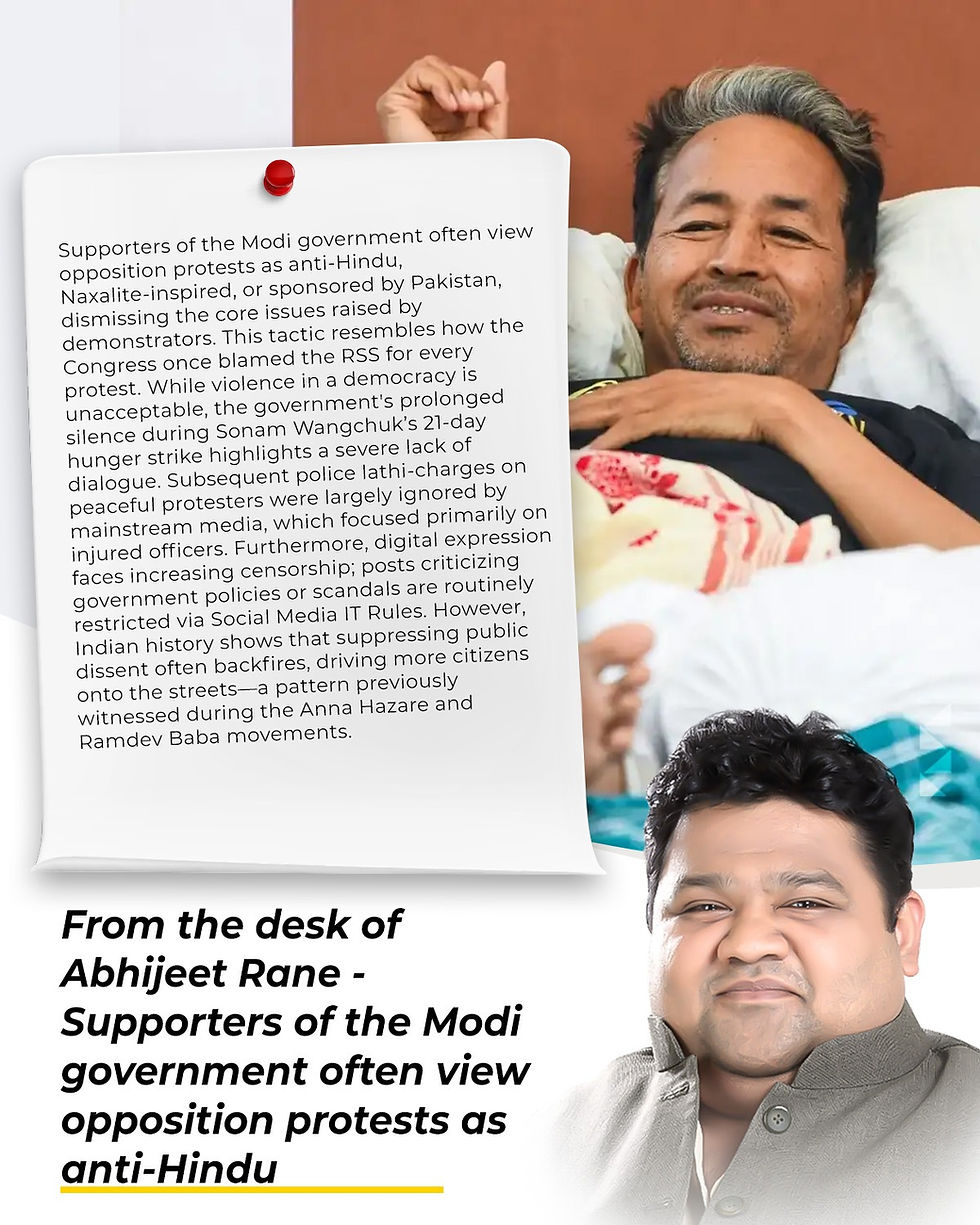
Supporters of the Modi government often view opposition protests as anti-Hindu...
🖋️ *From The Desk of Abhijeet Rane*
Supporters of the Modi government often view opposition protests as anti-Hindu, Naxalite-inspired, or sponsored by Pakistan, dismissing the core issues raised by demonstrators. This tactic resembles how the Congress once blamed the RSS for every protest. While violence in a democracy is unacceptable, the government's prolonged silence during Sonam Wangchuk’s 21-day hunger strike highlights a severe lack of dialogue. Subsequent police lathi-charges on peaceful protesters were largely ignored by mainstream media, which focused primarily on injured officers. Furthermore, digital expression faces increasing censorship; posts criticizing government policies or scandals are routinely restricted via Social Media IT Rules. However, Indian history shows that suppressing public dissent often backfires, driving more citizens onto the streets—a pattern previously witnessed during the Anna Hazare and Ramdev Baba movements.
🔽
🖋️ *From The Desk of Abhijeet Rane*
Those who currently argue that demanding Education Minister Dharmendra Pradhan’s resignation will not solve systemic issues are the same voices who previously criticized him during the controversy over UGC regulations. Back then, right-wing influencers demanded his resignation, accusing him of creating divisions within Hindu society through reservation policies, resulting in someone else taking the fall while he remained safe. These hypocritical shifts reveal that people judge leaders solely based on political convenience or who happens to be demanding accountability. When issues directly affected their specific caste or religious interests, they rushed to criticize the government and demand resignations. However, now that the issue centers on educational integrity and paper leaks affecting millions, they aggressively defend the administration simply because opposition voices are raising concerns. Ultimately, systemic failures impact every student regardless of political ideology.
🔽
🖋️ *From The Desk of Abhijeet Rane*
Opposition leaders frequently accuse the government of choking democracy and creating an "undeclared Emergency." However, these allegations lack factual basis. Parliament, state assemblies, and local bodies function freely. Fundamental rights—including voting, free speech, and the right to protest and criticize government policies—remain fully intact. Furthermore, press censorship is nonexistent, and unlawful detentions without legal recourse are not occurring. These exaggerated claims ignore historical reality. A genuine suppression of democracy occurred during the 21-month Emergency imposed by Indira Gandhi, which suspended fundamental rights and jailed political opponents without trial—an era these same critics rarely condemn. The present administration operates within constitutional frameworks. Labeling these democratic processes as authoritarian reflects political rhetoric rather than an actual breakdown of constitutional governance
🔽
🖋️ *From The Desk of Abhijeet Rane*
Critics often label the government dictatorial, yet democratic tools to challenge authority remain active and widely used. As AI models highlight, opposition parties can utilize parliamentary mechanisms, public mobilization, and judicial review to hold the government accountable. In India, opposition parties and citizens frequently approach the Supreme Court on policy and electoral issues. However, the courts have consistently upheld government actions as constitutional, dismissing claims of overreach. Furthermore, democratic elections provide the ultimate remedy, but repeated electoral losses have led critics to accuse key institutions and voters of corruption. By blaming courts, electoral bodies, and the electorate rather than evaluating their own strategies, the opposition risks ignoring basic democratic outcomes. Sustained public trust depends on addressing voter priorities rather than dismissing institutional decisions and election results.
🔽
🖋️ *From The Desk of Abhijeet Rane*
The Maharashtra government has decided to lease prime land within six major state-run hospitals to Gujarat-based Sevadan Arogya Foundation at a nominal rate of Re 1 per year for 49 years. Managed by Ahmedabad-based trust heads Harshad and Mohit Shah, the organization will construct dharamshalas (rest houses) to accommodate relatives accompanying hospitalized patients. Under the lease terms, upon expiration or early termination of the 49-year agreement, all constructed buildings and infrastructure will automatically revert to the state government without any financial compensation. Notably, the foundation has previously secured similar government land allotments for hospital rest houses across several states, including Gujarat, Uttar Pradesh, Rajasthan, Assam, Uttarakhand, and Chhattisgarh. The allotment of valuable public land has sparked widespread political debate.
🔽



Comments