


Reports that Uddhav Thackeray’s name appeared twice in Beed’s draft voter list...
🖋️ *From The Desk of Abhijeet Rane*
Reports that Uddhav Thackeray’s name appeared twice in Beed’s draft voter list would be politically explosive if both entries are conclusively verified as belonging to him. The irony is obvious: Maharashtra has just witnessed fierce political mobilisation over voter rolls, SIR and allegations surrounding electoral integrity. But this episode should not become an excuse for cheap personal ridicule. Instead, it strengthens the central argument for rigorous voter-roll purification. Duplicate entries can arise through migration, outdated records or administrative errors; their existence does not automatically prove that anyone voted twice. That distinction is crucial. Yet if prominent political figures themselves can appear more than once, imagine the scale of errors possible among crores of ordinary electors. The answer is neither to abandon verification nor politicise every deletion—the answer is a transparent system that removes duplicates without removing genuine voters.
🔽
🖋️ *From The Desk of Abhijeet Rane*
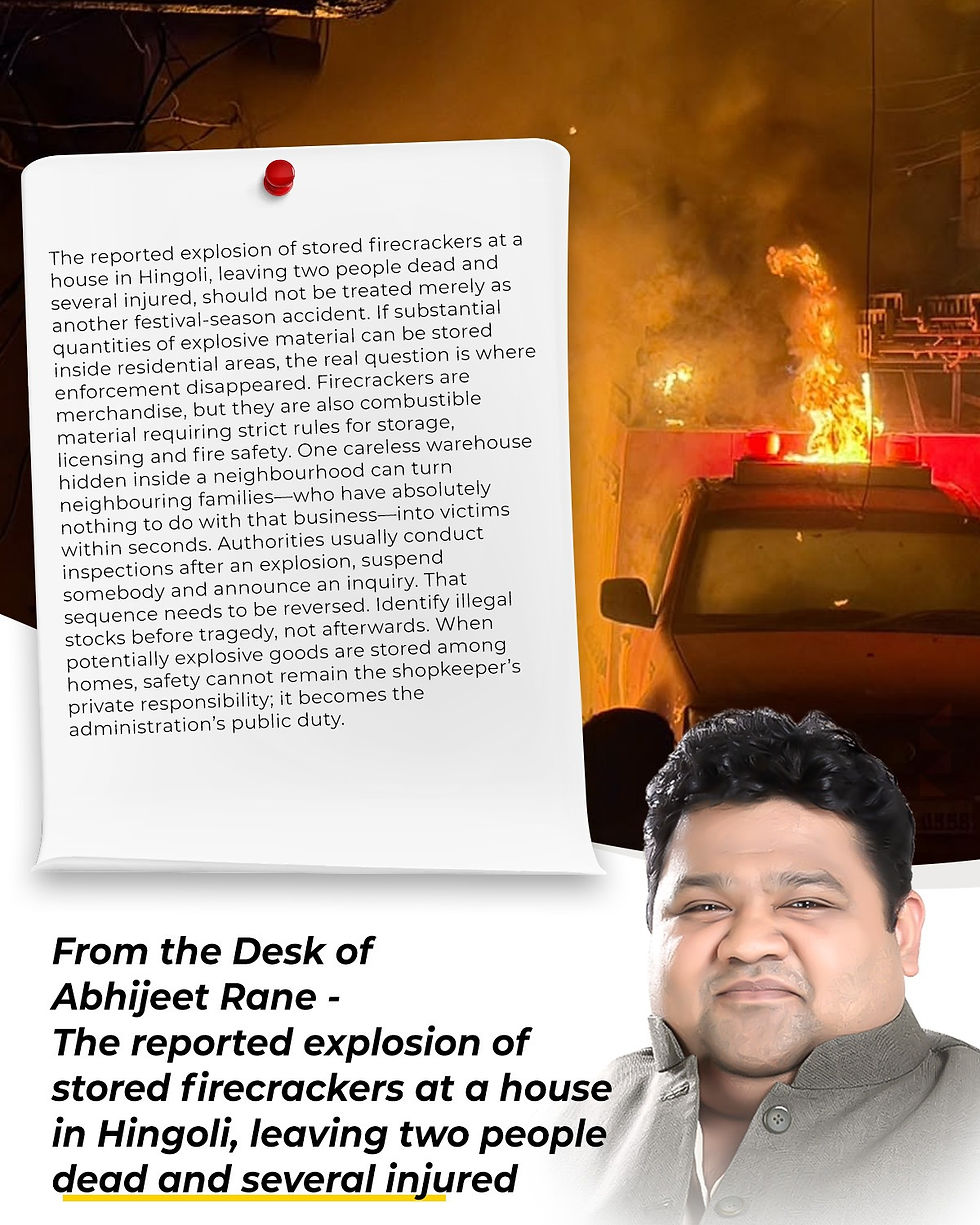
The reported explosion of stored firecrackers at a house in Hingoli, leaving two people dead and several injured, should not be treated merely as another festival-season accident. If substantial quantities of explosive material can be stored inside residential areas, the real question is where enforcement disappeared. Firecrackers are merchandise, but they are also combustible material requiring strict rules for storage, licensing and fire safety. One careless warehouse hidden inside a neighbourhood can turn neighbouring families—who have absolutely nothing to do with that business—into victims within seconds. Authorities usually conduct inspections after an explosion, suspend somebody and announce an inquiry. That sequence needs to be reversed. Identify illegal stocks before tragedy, not afterwards. When potentially explosive goods are stored among homes, safety cannot remain the shopkeeper’s private responsibility; it becomes the administration’s public duty.
🔽
🖋️ *From The Desk of Abhijeet Rane*
The protest against Thane’s Ring Metro once again exposes Maharashtra’s chronic failure to reconcile infrastructure with urban ecology. Citizens questioning tree cutting, displacement and alignment are not necessarily opposing development; they are asking whether development has been intelligently designed. Maharashtra certainly needs metros, roads and better connectivity, but every major project cannot begin with the assumption that trees, neighbourhoods and existing communities are expendable obstacles. Environmental impact assessments, alternative alignments and transparent public consultation should happen before decisions become virtually irreversible. Otherwise, governments create an unnecessary conflict between infrastructure and environment. The tragedy is that poorly planned urbanisation eventually defeats its own purpose—roads become congested, cities flood and temperatures rise. A metro may save twenty minutes of travel today, but destroying the ecology that makes a city liveable can cost generations tomorrow.
🔽
🖋️ *From The Desk of Abhijeet Rane*
President Donald Trump’s approval of the firing-squad execution of Nidal Hasan, convicted of killing 13 people and wounding dozens at Fort Hood in 2009, will inevitably reopen America’s death-penalty debate. There is little ambiguity about the horror of the crime or the suffering of victims’ families. Yet execution after seventeen years raises a different question: what exactly should punishment accomplish—retribution, deterrence or protection of society? Supporters will argue that an extraordinarily brutal crime deserves the ultimate punishment. Opponents will ask whether killing an already imprisoned murderer makes society safer. Both arguments deserve consideration. What cannot be forgotten is that debates about the offender often overshadow those whose lives were destroyed. A justice system must debate the morality of punishment, but it must never allow that debate to erase the victims from the story.
🔽
🖋️ *From The Desk of Abhijeet Rane*
Brazil’s presidential election has delivered a message that extends far beyond one candidate. Flávio Bolsonaro’s strong first-round performance against Lula suggests that the political movement built around the Bolsonaro name remains a formidable force. More importantly, markets reacted positively, indicating that investors are also reading the result through the prism of economic policy and political direction. The runoff will therefore not merely decide who occupies the presidential palace; it will test whether Brazil wants continuity under Lula or another decisive turn towards the Right. For years, critics assumed Bolsonaro-style politics would weaken once Jair Bolsonaro himself left centre stage. That assumption now looks premature. Political movements sometimes outgrow their founders. If Flávio eventually wins, Brazil will have demonstrated that Bolsonaro was not merely a man—it had become a political constituency.
🔽
#Maharashtra #Politics #VoterList #Hingoli #Safety #ThaneMetro #Environment #Trump #Brazil #Election #AbhijeetRane #MumbaiMitra



Comments