


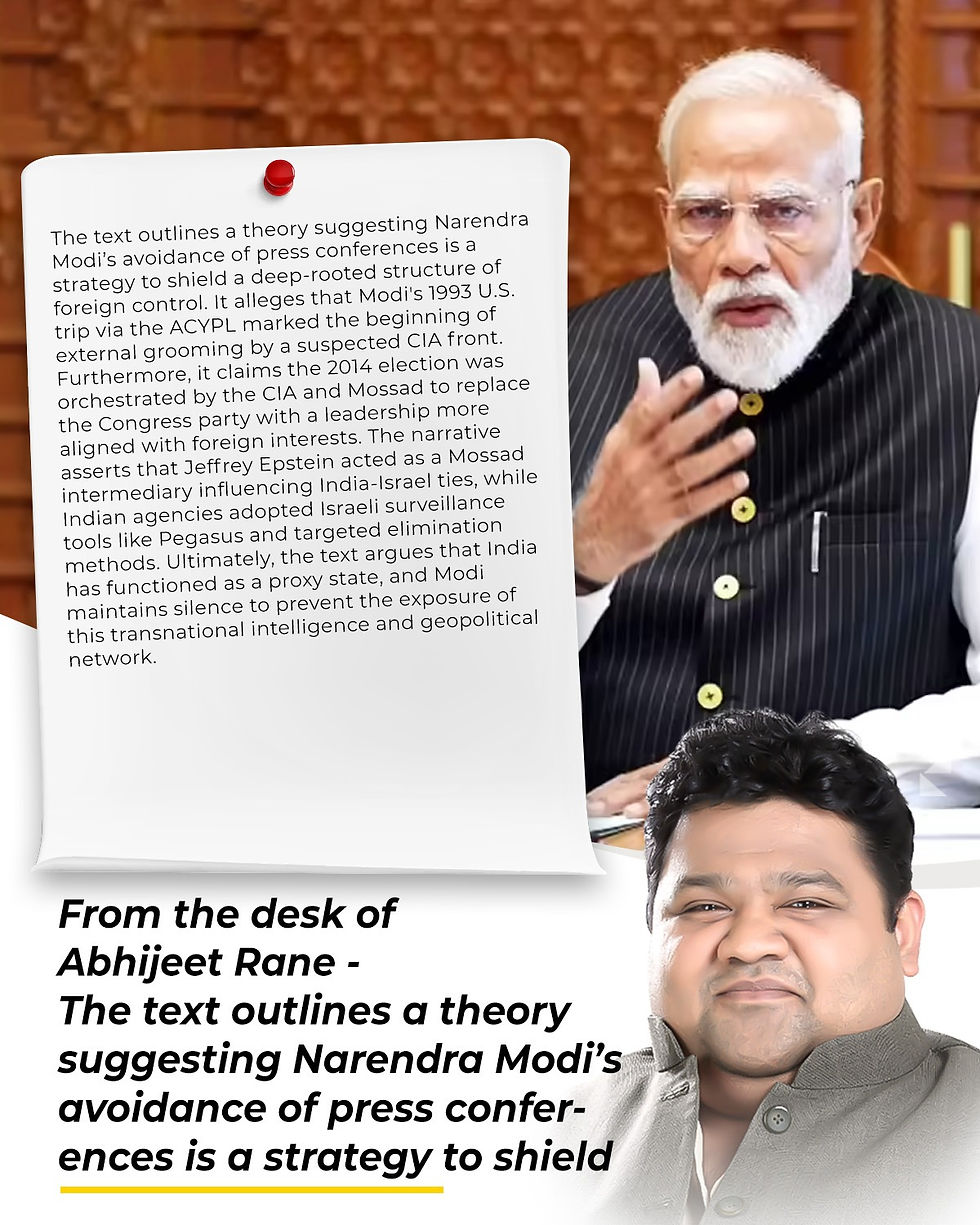
The text outlines a theory suggesting Narendra Modi’s avoidance of press conferences...
🖋️ *From The Desk of Abhijeet Rane*
The text outlines a theory suggesting Narendra Modi’s avoidance of press conferences is a strategy to shield a deep-rooted structure of foreign control. It alleges that Modi's 1993 U.S. trip via the ACYPL marked the beginning of external grooming by a suspected CIA front. Furthermore, it claims the 2014 election was orchestrated by the CIA and Mossad to replace the Congress party with a leadership more aligned with foreign interests. The narrative asserts that Jeffrey Epstein acted as a Mossad intermediary influencing India-Israel ties, while Indian agencies adopted Israeli surveillance tools like Pegasus and targeted elimination methods. Ultimately, the text argues that India has functioned as a proxy state, and Modi maintains silence to prevent the exposure of this transnational intelligence and geopolitical network.
🔽
🖋️ *From The Desk of Abhijeet Rane*
The local administration has ordered the management of Azam Khan’s university in Rampur to demolish 38 of its 40 buildings within 15 days due to unapproved construction maps, failing which the state will bulldoze them. Built as a major higher education institution rather than a personal estate, the campus successfully offered multiple degree courses until a change in government led to its closure and the imprisonment of its founder. While administrative and layout violations are cited, critics argue that demolishing an educational institution driven by political animosity is short-sighted. Instead of destruction, the state could easily nationalize the campus, rebrand it under a new name, and maintain its academic functions, highlighting a troubling trend where political polarization overrides public interest and educational infrastructure.
🔽
🖋️ *From The Desk of Abhijeet Rane*
The text outlines a historical critique of Indian communists, alleging a long-standing alignment with Islamic political movements and Pakistan's creation. It highlights the 1942 thesis by CPI leader Gangadhar Adhikari, which viewed India as a collection of separate nationalities rather than a unified country, advocating for the self-determination of religious and linguistic groups. The narrative states that following Germany’s invasion of the USSR, the CPI aligned with the British, abstaining from the 1942 Quit India Movement. Consequently, while Congress leaders were jailed, communists operated legally, supporting the Muslim League and legitimizing the demand for Pakistan. Furthermore, the text claims the CPI advocated partitioning India into 16 to 17 sovereign states, arguing that their historical actions consistently undermined the vision of a unified nation.
🔽
🖋️ *From The Desk of Abhijeet Rane*
The ultimate power center of Indian politics has shifted to a single room in Delhi, where the top four leaders of the BJP are meeting behind closed doors to finalize the future political landscape. This high-stakes meeting aims to settle all ongoing speculation and delays by making definitive decisions on critical governance issues. Key items on the agenda include locking in top ministerial portfolios, allocating cabinet slots, and drafting the blueprint for the NDA alliance. The leaders will single-handedly decide the inclusion terms for allies and determine the political fates of numerous hopefuls. With the future of the government being structurally locked in during these crucial hours, anxiety remains exceptionally high for hundreds of party leaders across the country as the official countdown concludes
🔽
🖋️ *From The Desk of Abhijeet Rane*
The escalating war between the US and Iran has severely disrupted global fuel supplies through the critical Strait of Hormuz, driving Brent crude oil prices up by 17%. In response to this sudden global price hike, the Indian central government has taken a decisive financial step by steeply raising the windfall tax on fuel exports. Under the newly implemented regulations, the export duty on diesel has jumped from ₹8.5 to ₹15.5 per liter, while the tax on aviation turbine fuel (ATF) has surged from ₹7.5 to ₹14.5 per liter. Conversely, the government reduced the export levy on petrol to ₹2.5 per liter. This strategic revision aims to regulate the domestic availability of fuel and absorb abnormal refinery profits amid heightened geopolitical vulnerabilities that continue to stress heavily oil-dependent economies like India.
🔽


Comments