


Student protests demanding reforms in Jharkhand’s JPSC exam highlight...
🖋️ *From The Desk of Abhijeet Rane*
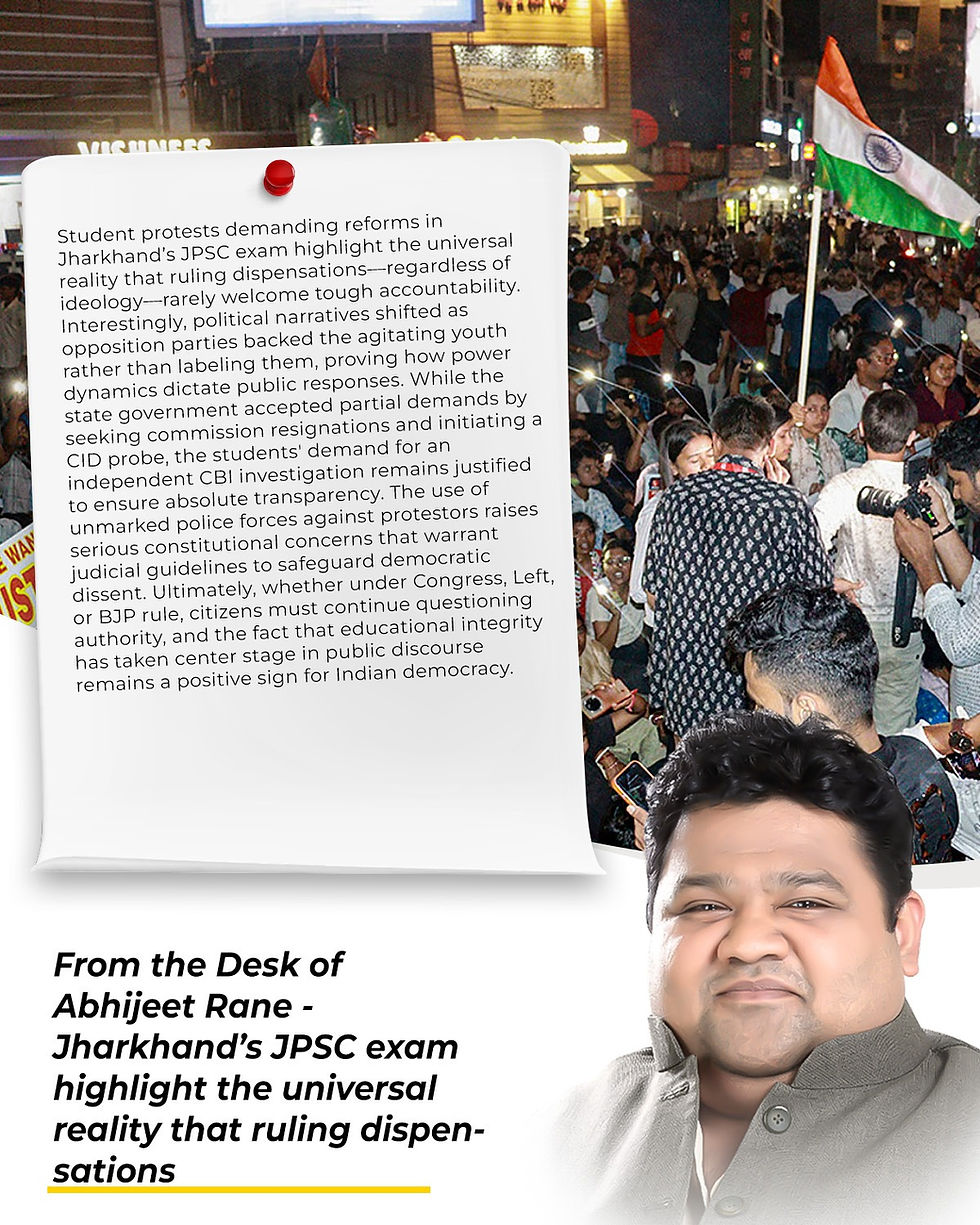
Student protests demanding reforms in Jharkhand’s JPSC exam highlight the universal reality that ruling dispensations—regardless of ideology—rarely welcome tough accountability. Interestingly, political narratives shifted as opposition parties backed the agitating youth rather than labeling them, proving how power dynamics dictate public responses. While the state government accepted partial demands by seeking commission resignations and initiating a CID probe, the students' demand for an independent CBI investigation remains justified to ensure absolute transparency. The use of unmarked police forces against protestors raises serious constitutional concerns that warrant judicial guidelines to safeguard democratic dissent. Ultimately, whether under Congress, Left, or BJP rule, citizens must continue questioning authority, and the fact that educational integrity has taken center stage in public discourse remains a positive sign for Indian democracy.
🔽
🖋️ *From The Desk of Abhijeet Rane*
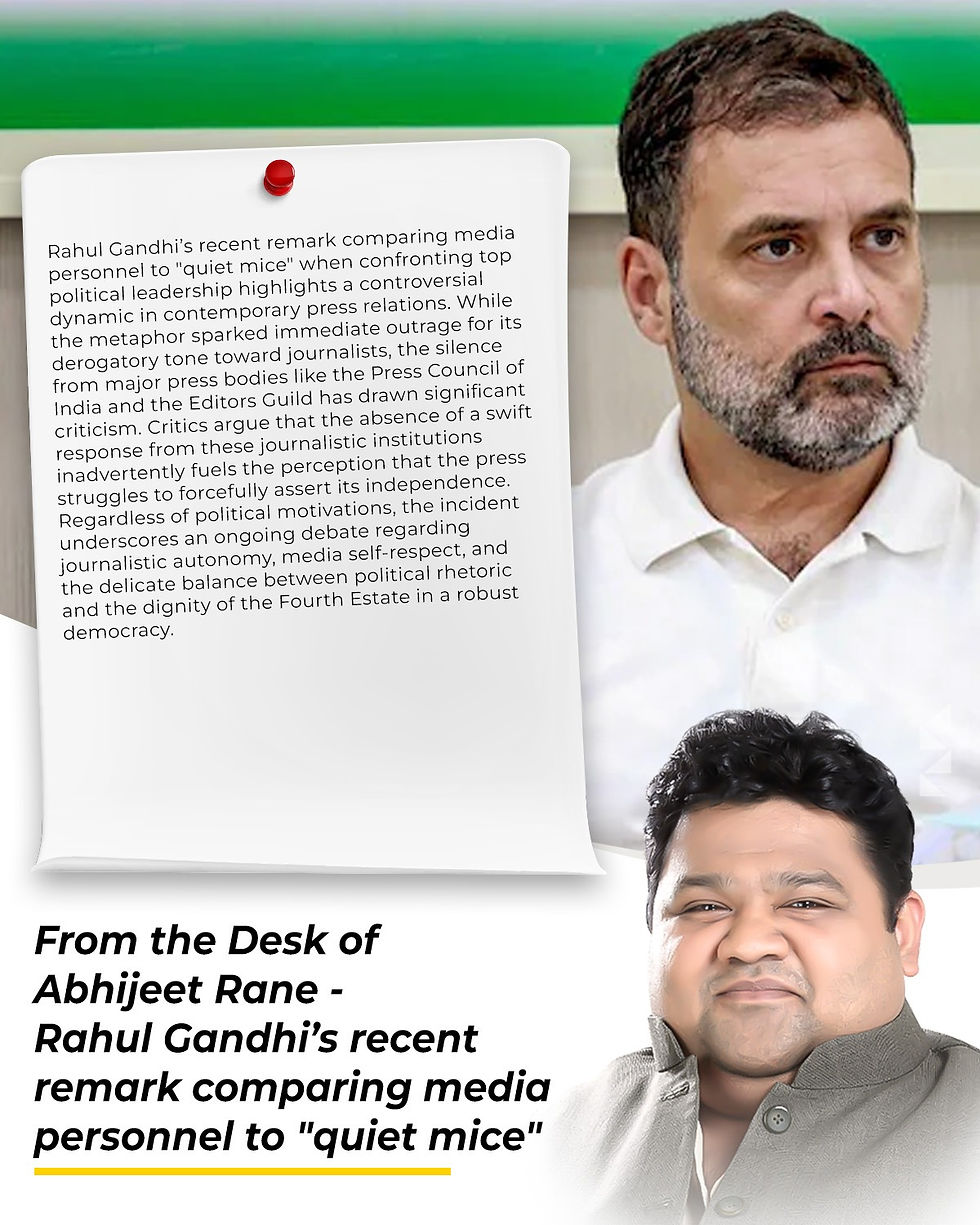
Rahul Gandhi’s recent remark comparing media personnel to "quiet mice" when confronting top political leadership highlights a controversial dynamic in contemporary press relations. While the metaphor sparked immediate outrage for its derogatory tone toward journalists, the silence from major press bodies like the Press Council of India and the Editors Guild has drawn significant criticism. Critics argue that the absence of a swift response from these journalistic institutions inadvertently fuels the perception that the press struggles to forcefully assert its independence. Regardless of political motivations, the incident underscores an ongoing debate regarding journalistic autonomy, media self-respect, and the delicate balance between political rhetoric and the dignity of the Fourth Estate in a robust democracy.
🔽
🖋️ *From The Desk of Abhijeet Rane*
The political controversy surrounding the Citizenship Amendment Act (CAA) and the National Register of Citizens (NRC) underscored how oppositional narratives often weaponize public anxieties for strategic gains. By instilling apprehension within minority communities, opposition parties sought to generate public outrage against state policies under the guise of civil resistance. However, as the seamless nationwide implementation of procedural exercises like Special Summary Revision (SIR) demonstrates, citizens readily comply with administrative requirements when policies do not threaten their rights. This transition highlights that initial fears were largely artificially magnified rather than grounded in reality. Continuously adopting a stance of opposition for the sake of political leverage, while disregarding national interests and policy outcomes, ultimately risks alienating voters who increasingly value constructive governance over perpetual skepticism.
🔽
🖋️ *From The Desk of Abhijeet Rane*
The Modi government’s opposition to applying the Non-Creamy Layer (NCL) principle to SC/ST reservations exposes a deep political reluctance to reform affirmative action. While historical injustice and social discrimination are undeniable realities, weaponizing them to deny intra-group equity undermines the very spirit of social justice. By allowing affluent members within SC/ST categories to repeatedly corner reservation benefits, the system effectively sidelines the most vulnerable and marginalized individuals who need state support the most. Refusing financial criteria or NCL limits creates a self-perpetuating elite within protected classes while ignoring grassroots deprivation. True empowerment demands dynamic policy evolution rather than rigid dogmatism; shielding economically prosperous individuals under the guise of historical oppression ultimately robs the truly underprivileged of their constitutional right to equal opportunity.
🔽
🖋️ *From The Desk of Abhijeet Rane*
The political discourse surrounding the Surjapuri Muslims in Bihar’s Seemanchal region highlights the sharp contradictions between electoral pragmatism and core ideological rhetoric. While the BJP-led NDA government moves to reclassify this socio-economically backward group from BC to the Extremely Backward Classes (EBC) category to consolidate crucial votes across key assembly seats, its broader national stance remains fiercely opposed to Muslim reservation elsewhere. Critics argue that when non-BJP states offer similar OBC benefits to Muslims, the party quickly labels it "appeasement" or an anti-majority agenda, yet adopts the same strategy for direct political survival in Bihar. This stark contrast suggests that ideological lines frequently blur when power is at stake, revealing that political convenience often overrides rhetoric, leaving core ideological stances as mere tools for mobilization during elections.
🔽
#JPSC #StudentProtests #Democracy #MediaFreedom #CAA #NRC #SocialJustice #Reservation #BiharPolitics #PoliticalAccountability #IndianPolitics #Governance #PublicInterest #AbhijeetRane




Comments