


On June 27, Uddhav Thackeray held rallies in Yavatmal...
🖋️ *From The Desk of Abhijeet Rane*
On June 27, Uddhav Thackeray held rallies in Yavatmal and Washim to boost morale among Shiv Sena (Uddhav faction) workers, sharply criticizing rebel MP Sanjay Deshmukh. Yet within 24 hours, 15 local office-bearers resigned, citing “personal reasons,” though all were known Deshmukh loyalists. This mass exit created turmoil in both districts and embarrassed Thackeray’s leadership. Observers noted the irony: while Thackeray mocked CM Devendra Fadnavis as “helpless” during a flight, he failed to foresee his own cadres abandoning him right after his tour. The resignations highlight the faction’s weakening grip and raise questions about Thackeray’s ability to control internal dissent. His leadership, intended to inspire unity, instead became a subject of ridicule as defections continue to erode the party’s strength.
🔽
🖋️ *From The Desk of Abhijeet Rane*
IPS officer Vishwas Nangre Patil praised the RSS in a public program, sparking anger from Raj Thackeray and Congress leaders. Their criticism, however, often rests on weak grounds. The main charge is that RSS did not participate in the freedom struggle. Yet its founder Dr. Hedgewar was once a Congress worker who even went to jail during protests. Another allegation is that RSS is not registered and does not pay income tax. But Congress ruled India for decades after independence—why did it not enforce registration or taxation then? Twice Congress banned RSS, and twice those bans had to be withdrawn. Constantly blaming RSS without credible reasons reflects political bias. If critics cannot provide solid evidence, then branding RSS as harmful becomes less about truth and more about prejudice.
🔽
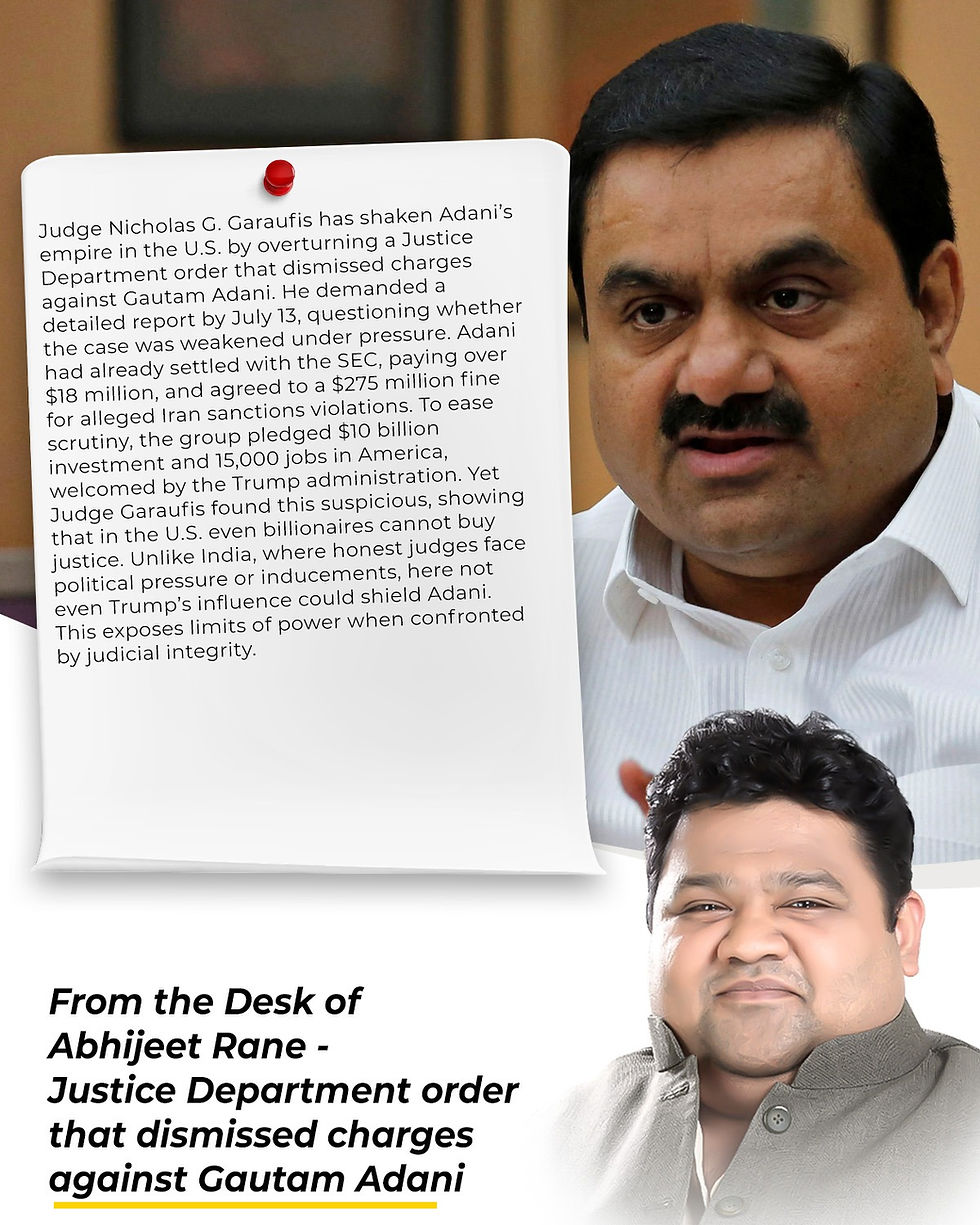
🖋️ *From The Desk of Abhijeet Rane*
Judge Nicholas G. Garaufis has shaken Adani’s empire in the U.S. by overturning a Justice Department order that dismissed charges against Gautam Adani. He demanded a detailed report by July 13, questioning whether the case was weakened under pressure. Adani had already settled with the SEC, paying over $18 million, and agreed to a $275 million fine for alleged Iran sanctions violations. To ease scrutiny, the group pledged $10 billion investment and 15,000 jobs in America, welcomed by the Trump administration. Yet Judge Garaufis found this suspicious, showing that in the U.S. even billionaires cannot buy justice. Unlike India, where honest judges face political pressure or inducements, here not even Trump’s influence could shield Adani. This exposes limits of power when confronted by judicial integrity.
🔽
🖋️ *From The Desk of Abhijeet Rane*
FDA Commissioner Tukaram Mundhe will not be transferred, as confirmed by Food and Drug Administration Minister Narhari Zirwal after demands from legislators across parties. Mundhe has introduced key reforms, reducing inefficiency and inspiring officers with his integrity, which has boosted public confidence. Yet his opponents cite alleged links to a drug lobby and ₹250 crore financial dealings, sparking political debate. The controversy raises a deeper question: is the system afraid of the law itself or of an honest officer who enforces it? Despite heavy pressure, Mundhe’s commitment to transparency has made him a symbol of clean governance. Supporting such principled officers is vital, as their work strengthens democracy and ensures accountability. Respecting their integrity is essential for the state and the nation’s future.
🔽
🖋️ *From The Desk of Abhijeet Rane*
The Terna Sugar Factory, once a lifeline for Dharashiv district, collapsed within just 5–6 years despite being operational with sugar stock in warehouses. Workers allege MP Omraje Nimbalkar drained the factory, even selling scrap, and later office fires destroyed records. Meanwhile, the same period saw the rise of Pawnaraje Multistate Bank, raising suspicions that funds were diverted from Terna to the bank for property purchases. Once a prosperous region, Dharashiv turned barren, while political leaders covered up the scandal. Now, with commissions drying up, leaders like Sanjay Raut are speaking out. Farmers and shareholders demand a CBI probe, insisting the truth of Terna’s destruction and Pawnaraje’s growth must be exposed. The case reflects deep corruption and the urgent need for accountability.
🔽




Comments