


The drowning of eight students during a trip to Diveagar...
🖋️ *From The Desk of Abhijeet Rane*
The drowning of eight students during a trip to Diveagar is not merely a tragic accident; it should trigger a serious review of safety rules governing educational and coaching-class excursions. Forty-eight students had reportedly travelled to the coastal destination when the tragedy occurred. Beaches can appear harmless even when underwater currents, sudden depth changes and waves create conditions that inexperienced visitors cannot recognise. Institutions taking minors or young students on excursions therefore carry a responsibility far greater than simply arranging transport and accommodation. Maharashtra needs enforceable protocols covering student-to-supervisor ratios, local lifeguards, designated safe zones, weather and sea-condition checks, emergency equipment and explicit restrictions on entering unsafe waters. Parents entrust institutions with their children believing basic risk assessment has been done. No safety system can eliminate every accident, but preventable deaths must force better rules. A recreational trip should never become a gamble with young lives.
🔽
🖋️ *From The Desk of Abhijeet Rane*
Maharashtra’s announcement of investment MoUs worth around ₹8.5 lakh crore, with a stated employment potential of about 2.91 lakh jobs, is unquestionably substantial. Data centres, IT-enabled services and semiconductors could strengthen the state’s position in industries that will shape India’s next economic cycle. Yet citizens should distinguish carefully between an MoU and an operational project. Investment announcements become economically meaningful only after land is acquired, statutory clearances are completed, financing is secured, construction begins, production starts and promised jobs are actually created. Maharashtra should therefore publish a transparent public dashboard tracking every major MoU from announcement to implementation, including committed investment, actual capital deployed, location, project status and employment generated. Such transparency would benefit the government as much as its critics because successful projects would become measurable achievements. Maharashtra does not merely need impressive investment announcements; it needs those crores converted into factories, technology, infrastructure and real paycheques.
🔽
🖋️ *From The Desk of Abhijeet Rane*
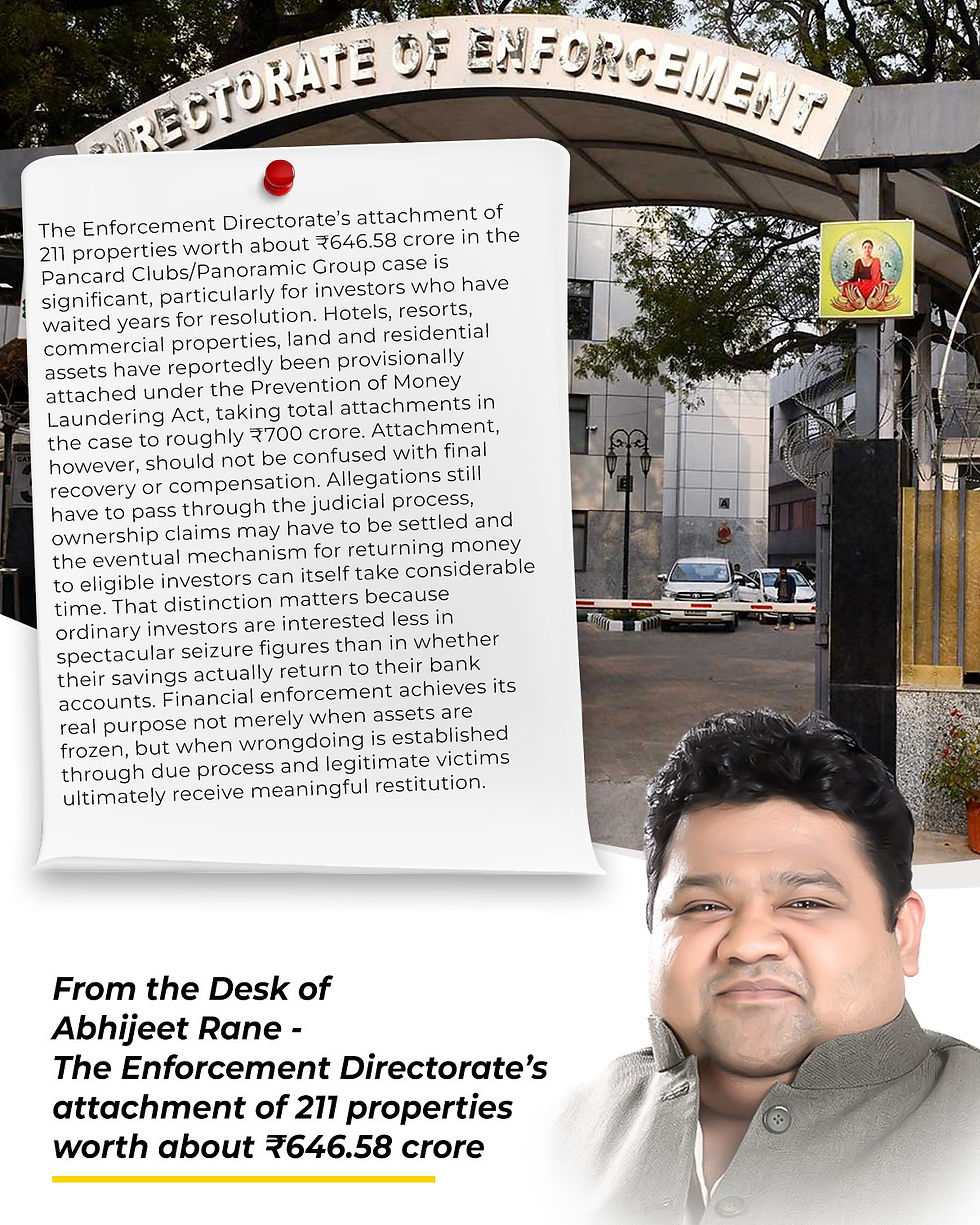
The Enforcement Directorate’s attachment of 211 properties worth about ₹646.58 crore in the Pancard Clubs/Panoramic Group case is significant, particularly for investors who have waited years for resolution. Hotels, resorts, commercial properties, land and residential assets have reportedly been provisionally attached under the Prevention of Money Laundering Act, taking total attachments in the case to roughly ₹700 crore. Attachment, however, should not be confused with final recovery or compensation. Allegations still have to pass through the judicial process, ownership claims may have to be settled and the eventual mechanism for returning money to eligible investors can itself take considerable time. That distinction matters because ordinary investors are interested less in spectacular seizure figures than in whether their savings actually return to their bank accounts. Financial enforcement achieves its real purpose not merely when assets are frozen, but when wrongdoing is established through due process and legitimate victims ultimately receive meaningful restitution.
🔽
🖋️ *From The Desk of Abhijeet Rane*
The Bombay High Court’s questions in the Mundhwa land case raise an important principle that goes beyond any individual politician or official: when a controversial transaction is investigated, should scrutiny stop with the officers who processed it, or should investigators also examine who ultimately stood to benefit? While granting anticipatory bail to a suspended tehsildar, the court questioned aspects of the investigation in a transaction involving a company in which Parth Pawar reportedly held a 99% stake. These observations do not establish anyone’s guilt, and the legal process must determine individual responsibility on evidence. Yet the larger governance issue deserves attention. In major land transactions, accountability cannot become disproportionately concentrated on lower-level officials while the role, knowledge and potential benefit of all relevant parties remain unexplored. A credible investigation must follow documents, decisions, money and beneficiaries without political considerations. Equal scrutiny is ultimately what gives an investigation public credibility.
🔽
🖋️ *From The Desk of Abhijeet Rane*
Pune’s growth story is increasingly colliding with a basic question: how many more people and buildings can the city’s existing infrastructure actually support? The Bombay High Court has issued notices to the Maharashtra government and Pune Municipal Corporation on a PIL challenging high-FSI provisions under UDCPR 2020. The petition raises concerns over density, carrying capacity and the pressure additional construction could place on roads, water supply, sewage systems and public amenities. Higher FSI is not inherently undesirable; compact urban development can reduce sprawl and make housing more viable. But allowing significantly greater construction without simultaneously expanding infrastructure can create precisely the congestion and civic stress Pune is already experiencing. The debate, therefore, should not simply be “development versus no development.” Every additional square foot permitted by planning authorities must be backed by corresponding capacity in roads, water, drainage, public transport and civic services. Cities cannot grow indefinitely on paper while their infrastructure remains frozen in the past.
🔽
#AbhijeetRane #MumbaiMitra #Maharashtra #StudentSafety #Investment #Jobs #ED #Pune #Infrastructure #Governance




Comments