


Maharashtra’s decision to introduce spot testing for spurious medicines deserves ...
🖋️ *From The Desk of Abhijeet Rane*
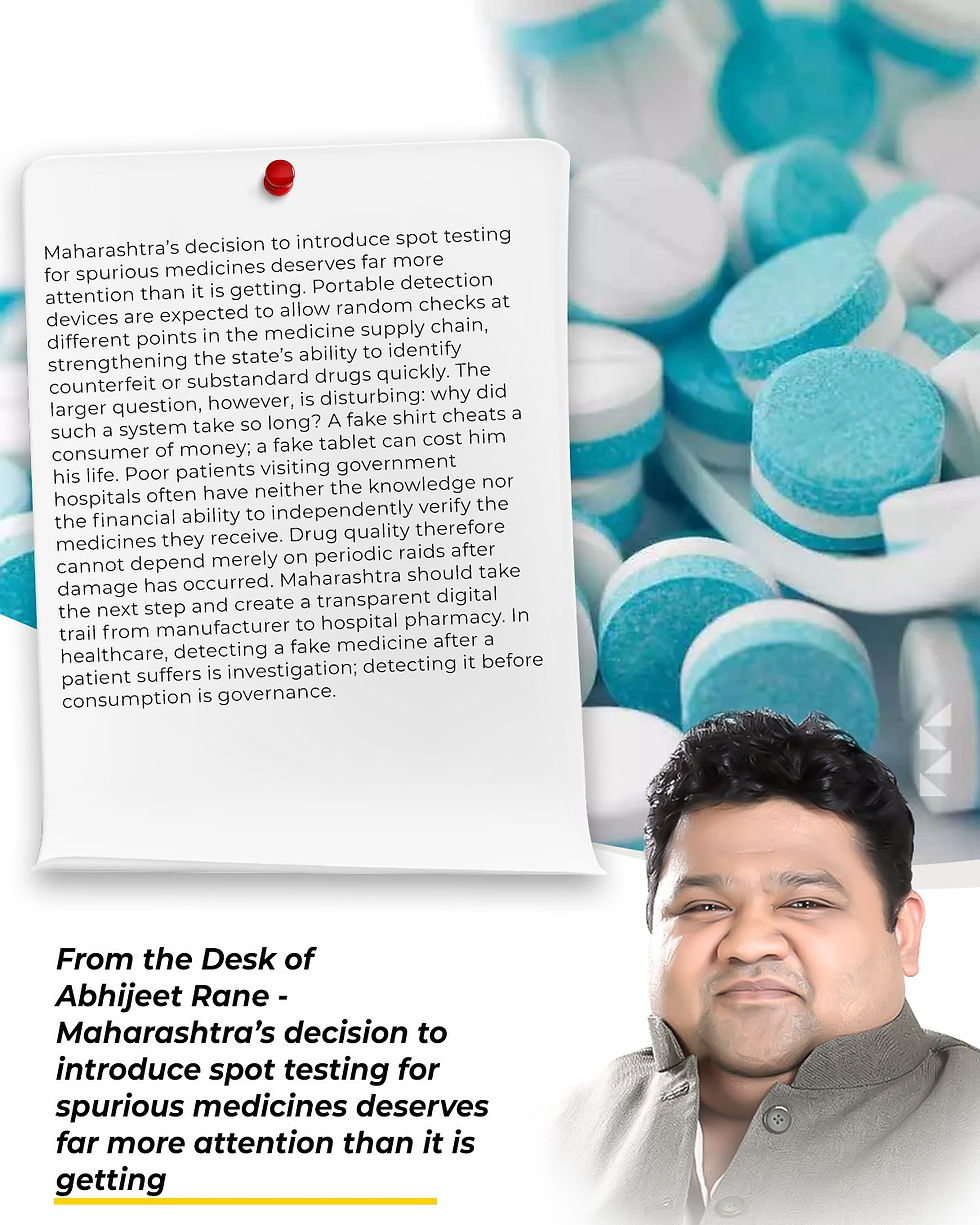
Maharashtra’s decision to introduce spot testing for spurious medicines deserves far more attention than it is getting. Portable detection devices are expected to allow random checks at different points in the medicine supply chain, strengthening the state’s ability to identify counterfeit or substandard drugs quickly. The larger question, however, is disturbing: why did such a system take so long? A fake shirt cheats a consumer of money; a fake tablet can cost him his life. Poor patients visiting government hospitals often have neither the knowledge nor the financial ability to independently verify the medicines they receive. Drug quality therefore cannot depend merely on periodic raids after damage has occurred. Maharashtra should take the next step and create a transparent digital trail from manufacturer to hospital pharmacy. In healthcare, detecting a fake medicine after a patient suffers is investigation; detecting it before consumption is governance.
🔽
🖋️ *From The Desk of Abhijeet Rane*
Maharashtra’s drought may soon reach urban dining tables through something as basic as a glass of milk. Milk procurement prices have risen sharply, with reports indicating rates moving from around ₹35 towards ₹42 per litre in parts of the market, raising the possibility of higher retail prices. The important story is not merely that milk may become costlier. Drought first reduces water and fodder, then affects cattle productivity, increases the farmer’s feeding cost, reduces milk availability and finally pushes up the consumer’s bill. This is how a rural climate crisis quietly becomes urban inflation. Governments traditionally respond to drought through crop compensation, tanker supply and relief packages. But livestock rarely receives equal policy attention. If Maharashtra’s climate pattern is structurally changing, fodder security, silage reserves and village-level water budgeting must become permanent infrastructure—not emergency measures announced after the cattle have already gone hungry.
🔽
🖋️ *From The Desk of Abhijeet Rane*
Pune will host a Centre of Excellence for Studies in Classical Marathi at the historic Deccan College, following approval from the Union government. The centre is expected to focus on research, preservation, digitisation and wider dissemination of Marathi’s linguistic heritage. This is where the celebration over Marathi receiving classical-language status must now turn into serious work. A language does not become globally important merely because government gives it a prestigious label. Thousands of manuscripts need digitisation, old dictionaries and inscriptions require modern scholarly study, and Marathi literature needs high-quality translations into major world languages. Artificial intelligence also creates an extraordinary opportunity to build massive searchable Marathi language databases. Pune already possesses institutions, scholars and an intellectual tradition capable of doing this. The real achievement will therefore not be inaugurating another building called a Centre of Excellence; it will be making centuries of Marathi knowledge accessible to the next century.
🔽
🖋️ *From The Desk of Abhijeet Rane*
A Pune solar-panel company losing about ₹4 crore in a CEO-impersonation cyber fraud should frighten corporate India more than another routine warning about suspicious links. Fraudsters allegedly impersonated senior management and persuaded employees to transfer company funds. The vulnerability here is not merely technological—it is organisational psychology. Employees are trained to question an unknown caller, but very few are trained to challenge an urgent instruction apparently coming from the boss. That hierarchy is precisely what modern cybercriminals exploit. Companies therefore need a simple rule: no large financial transfer should ever be authorised through WhatsApp, email or a single executive’s message, irrespective of designation. A second independent verification through a pre-registered channel must be compulsory. Cybersecurity is no longer only about firewalls and passwords; sometimes the biggest security flaw inside a company is an employee being too afraid to ask the boss, “Did you really send this?”
🔽
🖋️ *From The Desk of Abhijeet Rane*
Mumbai suffers from a chronic shortage of open space, yet 20 BMC-owned plots covering more than 330,000 square metres remain under the control of private organisations, trusts and other agencies. Some arrangements have existed for decades, while BMC says repossession awaits approval of a new policy. Organisations managing some plots, however, argue that their agreements predate the adoption policy or that they have themselves asked BMC to take the land back after reimbursing expenses. That makes transparency, rather than blanket accusation, essential. Publish the complete list: who controls each plot, under which agreement, for how long, what public access is guaranteed, what revenue is generated and why BMC has not reclaimed it. Mumbai reportedly has only about 0.88 sq m of open space per person. In such a city, every publicly owned playground and garden is not merely real estate—it is a scarce public resource, and citizens deserve to know exactly who controls it and why.
🔽
#Maharashtra #Mumbai #Pune #Healthcare #Drought #Marathi #CyberCrime #BMC #Governance #AbhijeetRane #MumbaiMitra






Comments