


🖋️ From The Desk of Abhijeet Rane
🖋️ From The Desk of Abhijeet Rane
Railways Tighten Rules on Unreserved Tickets
India’s digital revolution has transformed daily life, from mobile payments to booking train tickets through apps. Yet, the Indian Railways has now introduced a strict change: passengers traveling with unreserved tickets must carry a physical print copy. Showing the ticket on a mobile phone will no longer be accepted, and violators risk fines. This decision stems from rising fraud cases where advanced AI and photo-editing tools were used to create fake tickets that even passed QR code scans. A recent incident on the Jaipur route exposed such counterfeit tickets, causing revenue loss and raising security concerns. Reserved e-tickets booked via IRCTC remain valid digitally, but general tickets demand paper proof. Railways are also equipping TTEs with apps to verify authenticity. The move underscores balancing convenience with security in the digital age.
🔽
🖋️ From The Desk of Abhijeet Rane,
The “MaMu” Factor in Mumbai Politics
The recent alliance between Uddhav Thackeray’s faction and Raj Thackeray’s MNS has revived debate over the so‑called “MaMu” factor—Marathi and Muslim voter equations. Media surveys highlight that in Mumbai’s 227 BMC wards, 72 are dominated by Marathi voters while 41 hold significant Muslim influence. In the 2024 Lok Sabha elections, Muslim support helped Uddhav’s group secure key constituencies, though later Hindu consolidation reversed those gains. The new partnership suggests an attempt to combine traditional Marathi backing with Muslim solidarity to counter the BJP and Shinde’s Shiv Sena in upcoming civic polls. Yet, questions remain whether this is a genuine political strategy or a family‑centric arrangement. If Muslim voters mobilize strongly, these 41 wards could prove decisive. Conversely, a united Hindu‑Marathi vote may blunt the impact of this experiment.
🔽
🖋️ From The Desk of Abhijeet Rane
The Thackeray Brothers and Marathi Politics
After Raj Thackeray split from Shiv Sena, Uddhav Thackeray attempted to expand the party independently, while Raj initially gained 13 MLAs but failed to build further momentum. Nashik’s municipal power slipped away, and both leaders lost focus amid experiments and shifting alliances. Now, after years of setbacks, the brothers appear to reunite, but the critical question remains: what tangible benefit will this bring to the Marathi people? Political rhetoric often promises transformation, yet the lived reality of Marathi citizens in Pune, Nashik, or Mumbai shows little structural change. If permanent welfare were achieved, the emotional appeal of identity politics would lose its leverage. The challenge for the Thackerays is not merely unity but proving that their leadership can deliver beyond symbolism. Otherwise, the Marathi voter’s trust risks remaining unfulfilled.
🔽
🖋️ From The Desk of Abhijeet Rane
Media Power and Changing Platforms
Media has historically played a decisive role in shaping public perception, turning leaders into heroes or villains. In India, examples illustrate how narratives can elevate or diminish political figures. Yet, movements such as the Ambedkarite struggle often underestimated the importance of owning and sustaining media platforms. Dr. B.R. Ambedkar himself emphasized that a movement without its own press is like a bird with clipped wings. Earlier attempts at Ambedkarite newspapers and television channels faltered due to financial and structural challenges. However, the digital era has altered the landscape. With widespread internet penetration, platforms like YouTube now allow individuals and communities to create independent channels, bypassing traditional monopolies. Though resource-intensive, these efforts ensure voices remain relevant, accessible, and adaptable to future technologies, highlighting the continuing necessity of self-owned media.
🔽
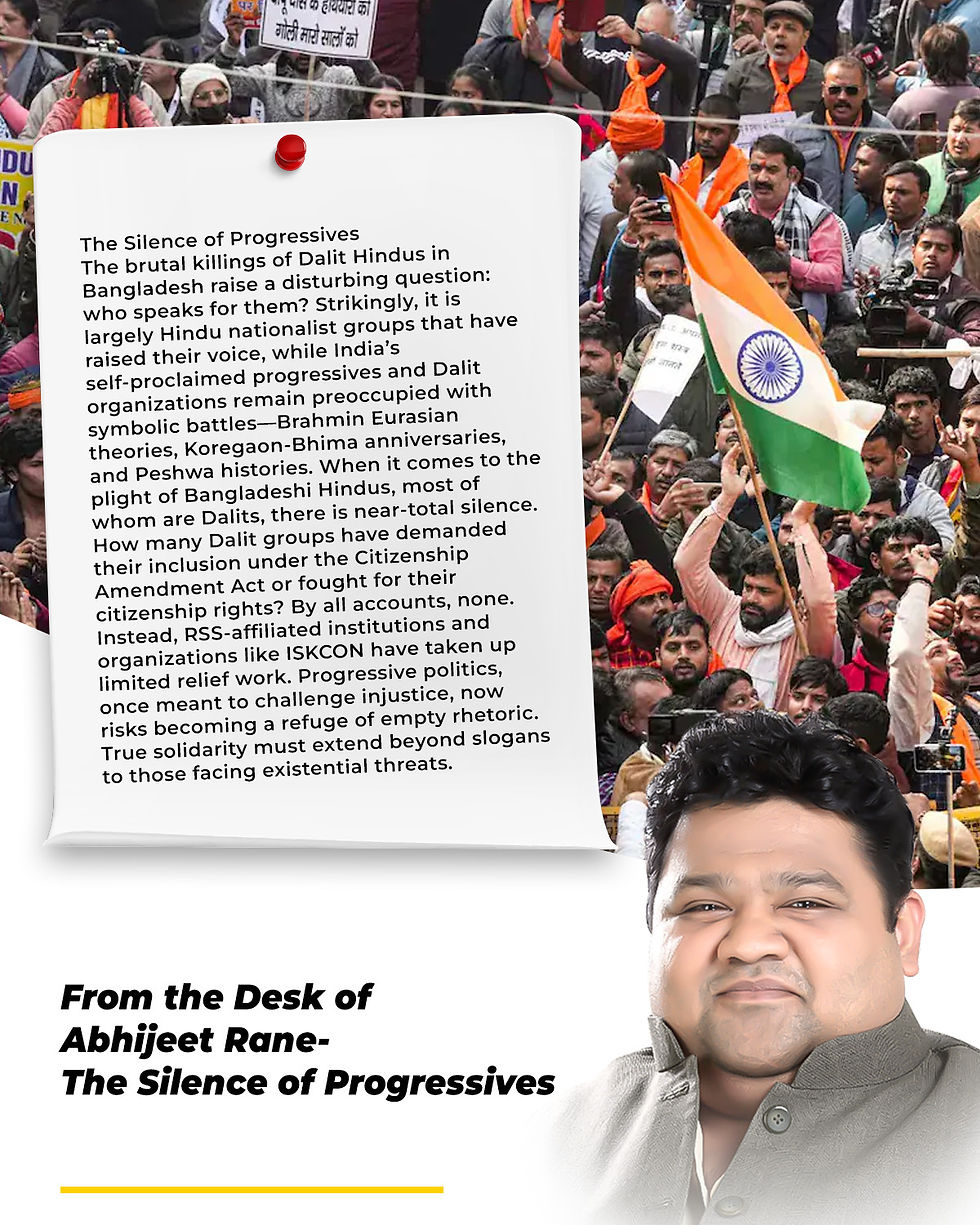
🖋️ From The Desk of Abhijeet Rane
The Silence of Progressives
The brutal killings of Dalit Hindus in Bangladesh raise a disturbing question: who speaks for them? Strikingly, it is largely Hindu nationalist groups that have raised their voice, while India’s self-proclaimed progressives and Dalit organizations remain preoccupied with symbolic battles—Brahmin Eurasian theories, Koregaon-Bhima anniversaries, and Peshwa histories. When it comes to the plight of Bangladeshi Hindus, most of whom are Dalits, there is near-total silence. How many Dalit groups have demanded their inclusion under the Citizenship Amendment Act or fought for their citizenship rights? By all accounts, none. Instead, RSS-affiliated institutions and organizations like ISKCON have taken up limited relief work. Progressive politics, once meant to challenge injustice, now risks becoming a refuge of empty rhetoric. True solidarity must extend beyond slogans to those facing existential threats.
🔽
#AbhijeetRane #IndianPolitics #RailwayReforms #DigitalIndia #MumbaiPolitics #MarathiPolitics #MediaAndPower #PoliticalAnalysis #IndianDemocracy #CurrentAffairs


Comments