


🖋️ From The Desk of Abhijeet Rane
🖋️ From The Desk of Abhijeet Rane
Shadows Beneath Bengal’s Border
Reports of Hamas-style tunnels allegedly linking West Bengal to Bangladesh, used by illegal migrants and smugglers, raise grave national security concerns. If such networks exist, they represent not just a law-and-order failure but a direct threat to India’s sovereignty. The political blame game between Mamata Banerjee’s government and the Centre only deepens the crisis. Banerjee has often resisted fencing projects along the border, citing land issues, but critics argue this reluctance enables infiltration. Meanwhile, the Centre’s silence appears equally troubling—security lapses cannot be brushed aside for political convenience. India cannot afford porous borders that invite trafficking, extremism, and instability. Accountability must be demanded from both state and central leadership. National security is not theatre; it is the bedrock of a nation’s survival.
🔽
🖋️ From The Desk of Abhijeet Rane,
Sangamner’s Shifting Chessboard
The political theatre in Sangamner has taken a sharp turn after Congress stalwart Balasaheb Thorat’s setback in the assembly polls. Choosing to step back, Thorat allowed young MLA Satyajit Tambe to lead through the newly minted Sangamner Seva Samiti, even fielding his wife as a candidate. Tambe’s bold move to abandon the Congress symbol and contest under Forward Bloc’s lion emblem signaled a break from tradition, while his claim of BJP support added intrigue. Thorat, however, struck back when Shinde’s camp dangled an MIDC promise, ridiculing it as hollow populism. Tambe’s counterstroke—his “Sangamner 2.0” vision—projects him as the town’s future leader. Yet Thorat’s daughter Jayashree faces a narrowing path, and whether Thorat reclaims ground or Tambe consolidates power will define the next assembly battle.
🔽
🖋️ From The Desk of Abhijeet Rane
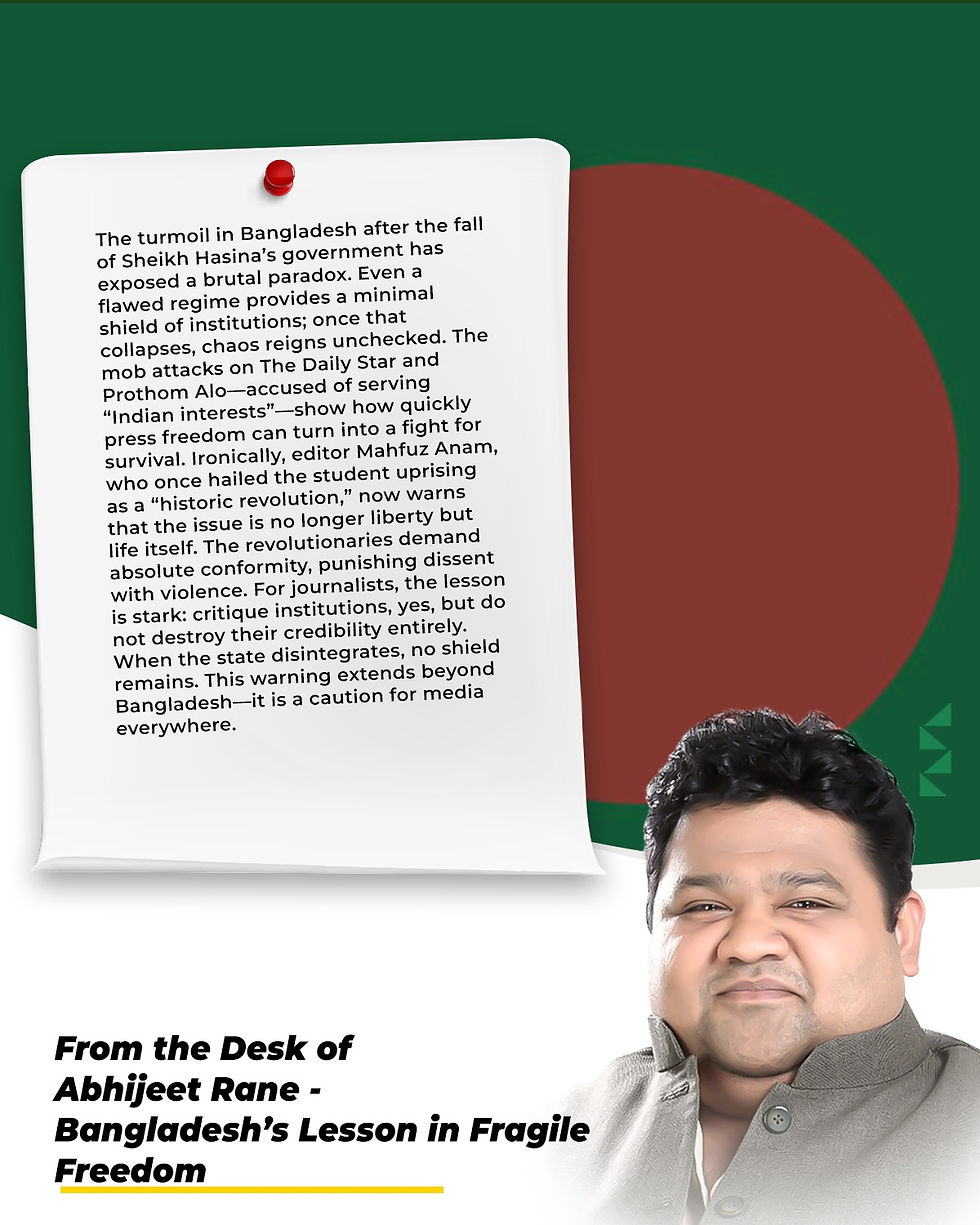
Bangladesh’s Lesson in Fragile Freedom
The turmoil in Bangladesh after the fall of Sheikh Hasina’s government has exposed a brutal paradox. Even a flawed regime provides a minimal shield of institutions; once that collapses, chaos reigns unchecked. The mob attacks on The Daily Star and Prothom Alo—accused of serving “Indian interests”—show how quickly press freedom can turn into a fight for survival. Ironically, editor Mahfuz Anam, who once hailed the student uprising as a “historic revolution,” now warns that the issue is no longer liberty but life itself. The revolutionaries demand absolute conformity, punishing dissent with violence. For journalists, the lesson is stark: critique institutions, yes, but do not destroy their credibility entirely. When the state disintegrates, no shield remains. This warning extends beyond Bangladesh—it is a caution for media everywhere.
🔽
🖋️ From The Desk of Abhijeet Rane
India’s Rise and Western Anxiety
India’s slow but steady march toward self-reliance in defense and technology is reshaping global power equations. The Advanced Medium Combat Aircraft (AMCA) project, though delayed by reluctance of Western firms to share jet engine technology, symbolizes India’s ambition to break dependency. France’s Safran and even Russia have withheld know-how, underscoring how strategic autonomy unsettles established powers. Meanwhile, India’s push for alternatives to the dollar—through UPI adoption across thirty nations and rupee-based oil trade with Russia—signals a challenge to financial hegemony. For the West, facing recession and waning influence, India’s emergence as the third global force after China is uncomfortable. Hence, political pressure and attempts to weaken Prime Minister Modi’s leadership are seen by many as deliberate. Yet India’s trajectory suggests resilience, not retreat, in its mission of sovereignty.
🔽
🖋️ From The Desk of Abhijeet Rane
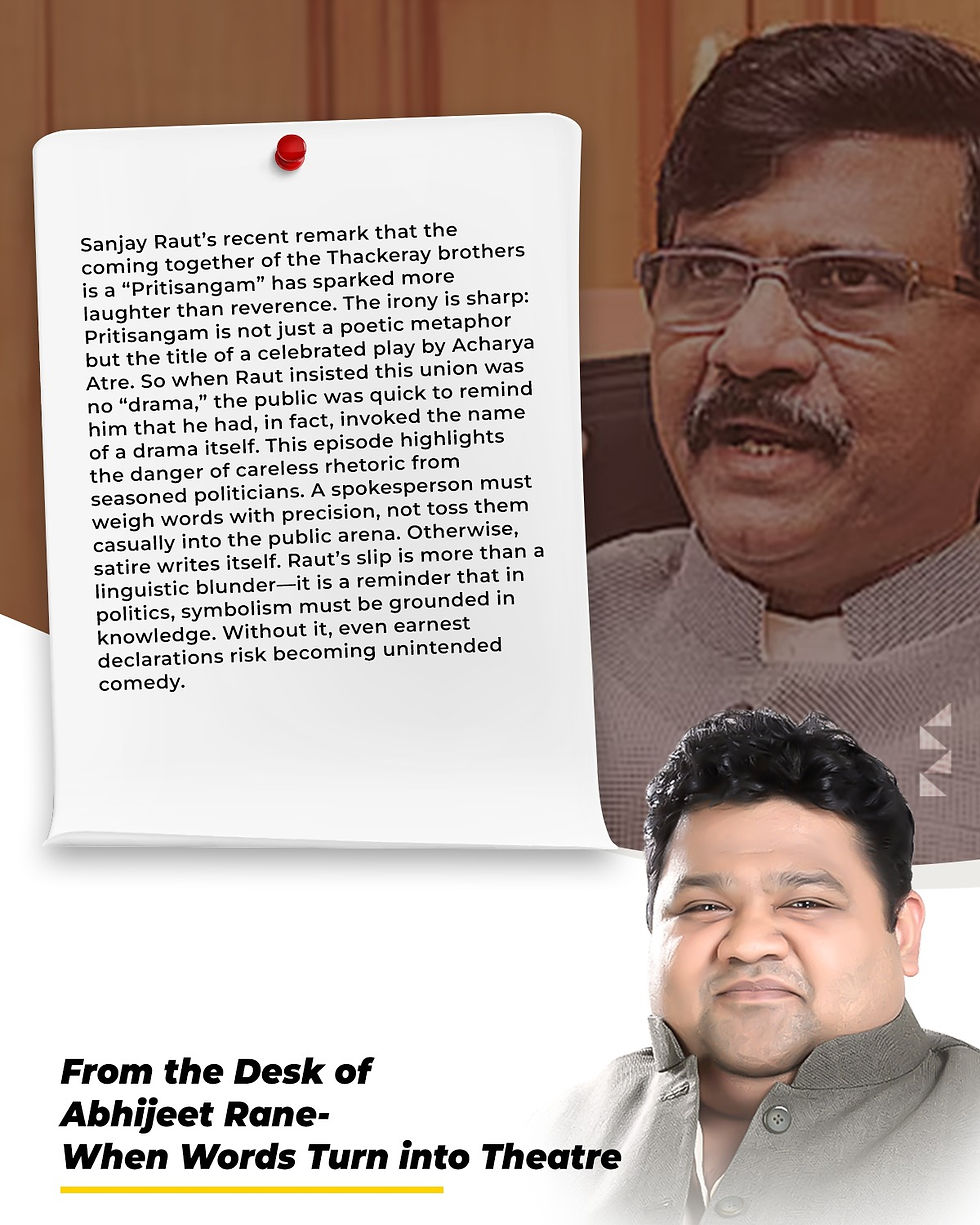
When Words Turn into Theatre
Sanjay Raut’s recent remark that the coming together of the Thackeray brothers is a “Pritisangam” has sparked more laughter than reverence. The irony is sharp: Pritisangam is not just a poetic metaphor but the title of a celebrated play by Acharya Atre. So when Raut insisted this union was no “drama,” the public was quick to remind him that he had, in fact, invoked the name of a drama itself. This episode highlights the danger of careless rhetoric from seasoned politicians. A spokesperson must weigh words with precision, not toss them casually into the public arena. Otherwise, satire writes itself. Raut’s slip is more than a linguistic blunder—it is a reminder that in politics, symbolism must be grounded in knowledge. Without it, even earnest declarations risk becoming unintended comedy.
🔽
#AbhijeetRane #MamataBanerjee #BalasahebThorat #SatyajitTambe #JayashreeThorat #SheikhHasina #MahfuzAnam #SanjayRaut #ThackerayBrothers #NarendraModi #NationalSecurity #IndianPolitics #BorderSecurity #MediaFreedom #PowerPolitics #DevendraFadnavis


Comments