


A democracy cannot treat a legislator’s mandate like transferable property...
🖋️ *From The Desk of Abhijeet Rane*
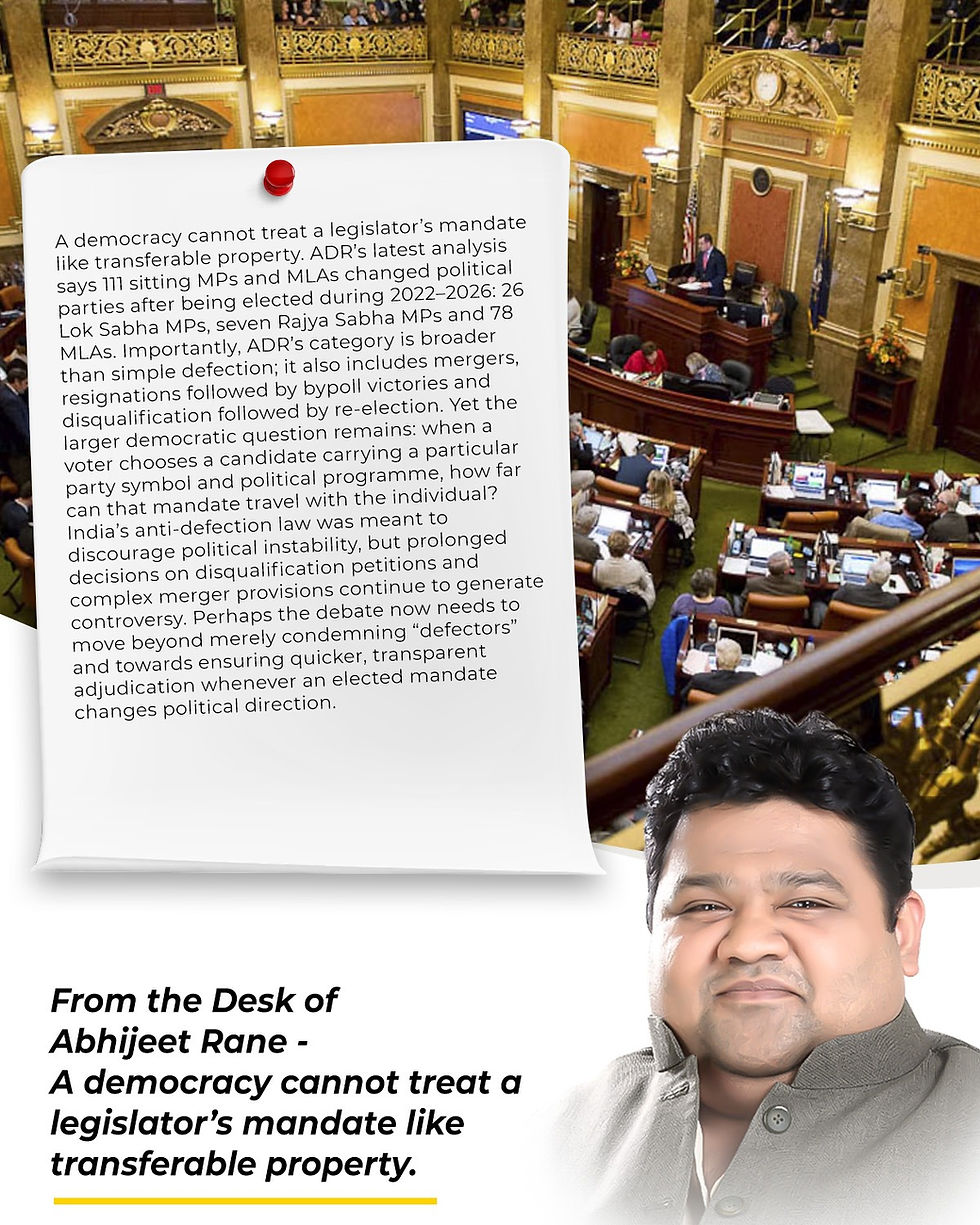
A democracy cannot treat a legislator’s mandate like transferable property. ADR’s latest analysis says 111 sitting MPs and MLAs changed political parties after being elected during 2022–2026: 26 Lok Sabha MPs, seven Rajya Sabha MPs and 78 MLAs. Importantly, ADR’s category is broader than simple defection; it also includes mergers, resignations followed by bypoll victories and disqualification followed by re-election. Yet the larger democratic question remains: when a voter chooses a candidate carrying a particular party symbol and political programme, how far can that mandate travel with the individual? India’s anti-defection law was meant to discourage political instability, but prolonged decisions on disqualification petitions and complex merger provisions continue to generate controversy. Perhaps the debate now needs to move beyond merely condemning “defectors” and towards ensuring quicker, transparent adjudication whenever an elected mandate changes political direction.
🔽
🖋️ *From The Desk of Abhijeet Rane*
The Supreme Court giving the Centre a “last chance” to explain action taken against online child sexual abuse material should worry us for a reason larger than courtroom compliance. The Court has sought an action-taken report from the concerned ministries on directions issued in September 2024. Technology has made creation, storage and circulation of abusive material frighteningly easy, while AI-generated and manipulated imagery adds another layer of complexity. This cannot be treated merely as objectionable internet content; behind genuine abuse material is a child whose exploitation can be perpetuated every time the material circulates. India therefore needs faster reporting and takedown systems, specialised cyber-police capacity, platform accountability and, crucially, victim-centred investigation. At the same time, enforcement mechanisms need clear legal safeguards against erroneous automated identification. Protecting children online requires technological capability, institutional speed and due process working together—not another compliance report gathering dust.
🔽
🖋️ *From The Desk of Abhijeet Rane*
Four women wrestlers have approached a sessions court challenging the magistrate’s order that acquitted former Wrestling Federation of India chief Brij Bhushan Sharan Singh and Vinod Tomar in a sexual-harassment case. Their appeal alleges selective appreciation of evidence and challenges aspects of the trial court’s reasoning. The important principle now is straightforward: an acquittal is legally significant, but the law also provides an appellate process through which such a judgment can be questioned. Public debate should therefore resist doing what courts themselves have not finally done—declaring guilt or innocence beyond the judicial process. This case has already generated intense political and social argument because it involves prominent athletes and a former influential sports administrator. The appellate court now has the responsibility of examining the record, evidence and reasoning. Justice requires seriousness towards complainants as well as the presumption of innocence and procedural rights of the accused.
🔽
🖋️ *From The Desk of Abhijeet Rane*
Benjamin Netanyahu’s address to the UN General Assembly produced an extraordinary diplomatic spectacle as delegations from numerous countries walked out when the Israeli Prime Minister took the podium. Reports described participation by representatives from scores of countries, reflecting the depth of international opposition to Israel’s conduct in Gaza, even as Israel continues to defend its military campaign and Netanyahu retains important international backing, particularly from the United States. A walkout does not itself change military realities, secure a ceasefire or resolve the Israeli-Palestinian conflict. But diplomacy has its own language, and an emptying hall is unmistakably part of it. Israel now faces not merely military and security questions but a serious contest over international legitimacy and diplomatic relationships. The harder question is whether symbolic isolation can translate into negotiations capable of protecting civilians, releasing hostages and producing a durable political settlement—or whether the symbolism simply hardens positions further.
🔽
🖋️ *From The Desk of Abhijeet Rane*
Volodymyr Zelenskyy says Ukraine is “very open” to Türkiye hosting a trilateral leaders’ meeting with Russia, putting Ankara once again into the diplomatic conversation around ending the war. Türkiye occupies an unusual position: a NATO member with working channels to both Kyiv and Moscow, substantial Black Sea interests and previous experience facilitating negotiations and grain arrangements. Zelenskyy and Recep Tayyip Erdoğan have also discussed Black Sea security and restoring maritime food-export routes. None of this means peace is around the corner. Territorial disputes, security guarantees, sovereignty and the terms of any ceasefire remain fundamental obstacles, while fighting continues. But after years of enormous human and economic cost, maintaining credible negotiating channels matters even when agreement appears distant. Türkiye’s usefulness may lie less in producing an instant grand settlement and more in creating smaller workable agreements—shipping, energy, prisoners or ceasefire mechanisms—from which wider negotiations could eventually grow.
🔽
#AbhijeetRane #Democracy #Politics #Justice #ChildSafety #Gaza #Israel #Ukraine #Russia #Diplomacy #MumbaiMitra




Comments