


The political temperature in Bhor has risen sharply ahead...
🖋️ *From The Desk of Abhijeet Rane*
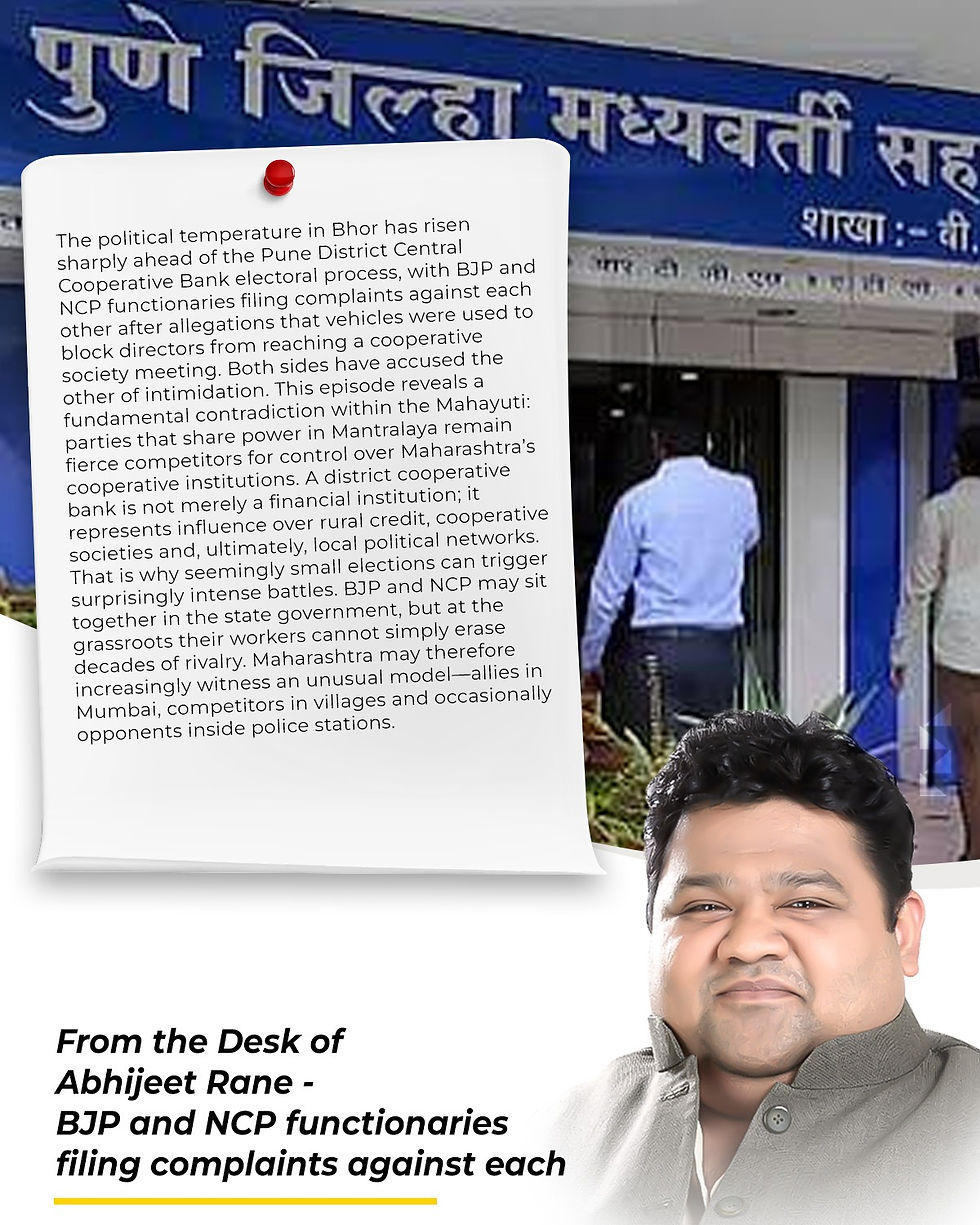
The political temperature in Bhor has risen sharply ahead of the Pune District Central Cooperative Bank electoral process, with BJP and NCP functionaries filing complaints against each other after allegations that vehicles were used to block directors from reaching a cooperative society meeting. Both sides have accused the other of intimidation. This episode reveals a fundamental contradiction within the Mahayuti: parties that share power in Mantralaya remain fierce competitors for control over Maharashtra’s cooperative institutions. A district cooperative bank is not merely a financial institution; it represents influence over rural credit, cooperative societies and, ultimately, local political networks. That is why seemingly small elections can trigger surprisingly intense battles. BJP and NCP may sit together in the state government, but at the grassroots their workers cannot simply erase decades of rivalry. Maharashtra may therefore increasingly witness an unusual model—allies in Mumbai, competitors in villages and occasionally opponents inside police stations.
🔽
🖋️ *From The Desk of Abhijeet Rane*
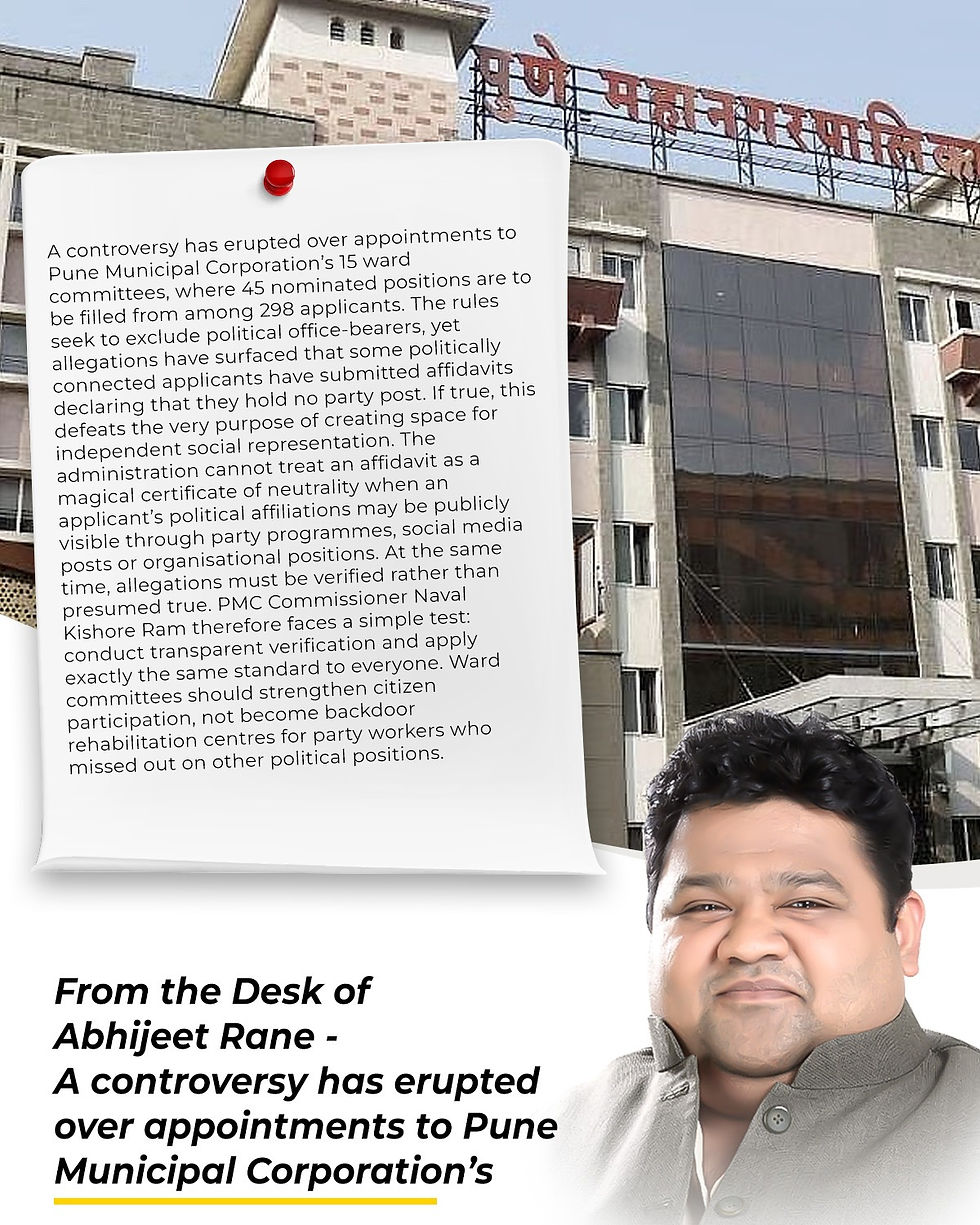
A controversy has erupted over appointments to Pune Municipal Corporation’s 15 ward committees, where 45 nominated positions are to be filled from among 298 applicants. The rules seek to exclude political office-bearers, yet allegations have surfaced that some politically connected applicants have submitted affidavits declaring that they hold no party post. If true, this defeats the very purpose of creating space for independent social representation. The administration cannot treat an affidavit as a magical certificate of neutrality when an applicant’s political affiliations may be publicly visible through party programmes, social media posts or organisational positions. At the same time, allegations must be verified rather than presumed true. PMC Commissioner Naval Kishore Ram therefore faces a simple test: conduct transparent verification and apply exactly the same standard to everyone. Ward committees should strengthen citizen participation, not become backdoor rehabilitation centres for party workers who missed out on other political positions.
🔽
🖋️ *From The Desk of Abhijeet Rane*
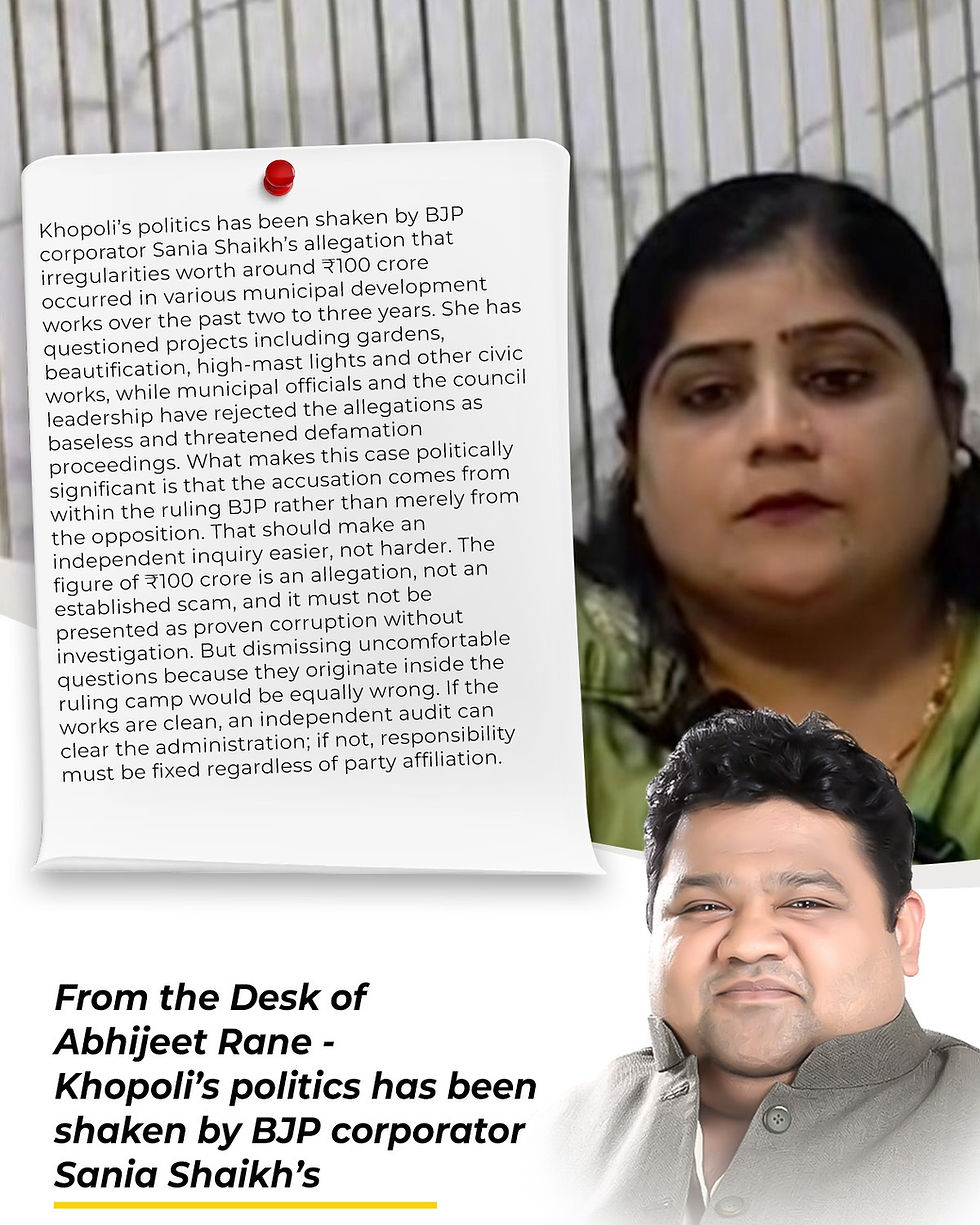
Khopoli’s politics has been shaken by BJP corporator Sania Shaikh’s allegation that irregularities worth around ₹100 crore occurred in various municipal development works over the past two to three years. She has questioned projects including gardens, beautification, high-mast lights and other civic works, while municipal officials and the council leadership have rejected the allegations as baseless and threatened defamation proceedings. What makes this case politically significant is that the accusation comes from within the ruling BJP rather than merely from the opposition. That should make an independent inquiry easier, not harder. The figure of ₹100 crore is an allegation, not an established scam, and it must not be presented as proven corruption without investigation. But dismissing uncomfortable questions because they originate inside the ruling camp would be equally wrong. If the works are clean, an independent audit can clear the administration; if not, responsibility must be fixed regardless of party affiliation.
🔽
🖋️ *From The Desk of Abhijeet Rane*
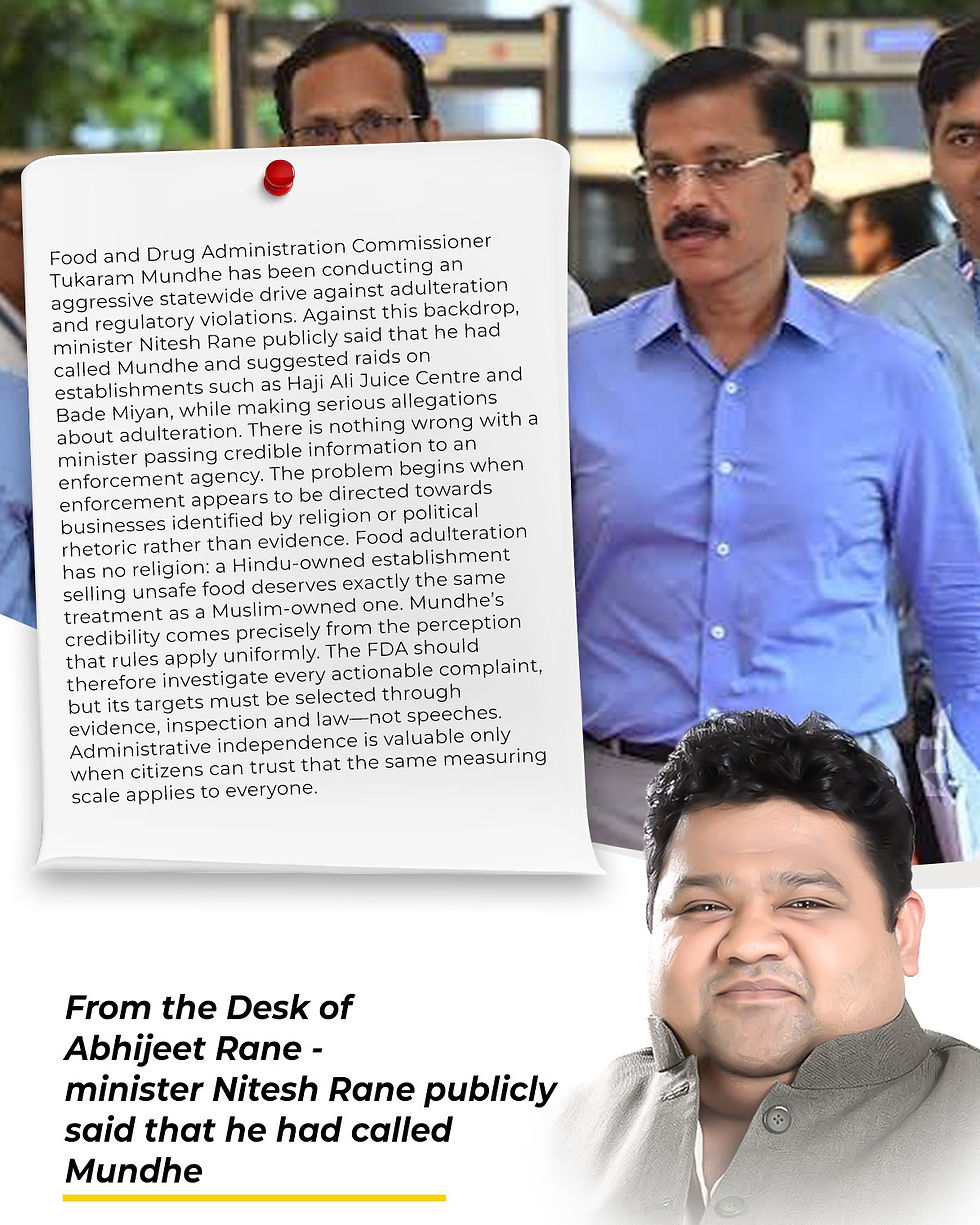
Food and Drug Administration Commissioner Tukaram Mundhe has been conducting an aggressive statewide drive against adulteration and regulatory violations. Against this backdrop, minister Nitesh Rane publicly said that he had called Mundhe and suggested raids on establishments such as Haji Ali Juice Centre and Bade Miyan, while making serious allegations about adulteration. There is nothing wrong with a minister passing credible information to an enforcement agency. The problem begins when enforcement appears to be directed towards businesses identified by religion or political rhetoric rather than evidence. Food adulteration has no religion: a Hindu-owned establishment selling unsafe food deserves exactly the same treatment as a Muslim-owned one. Mundhe’s credibility comes precisely from the perception that rules apply uniformly. The FDA should therefore investigate every actionable complaint, but its targets must be selected through evidence, inspection and law—not speeches. Administrative independence is valuable only when citizens can trust that the same measuring scale applies to everyone.
🔽
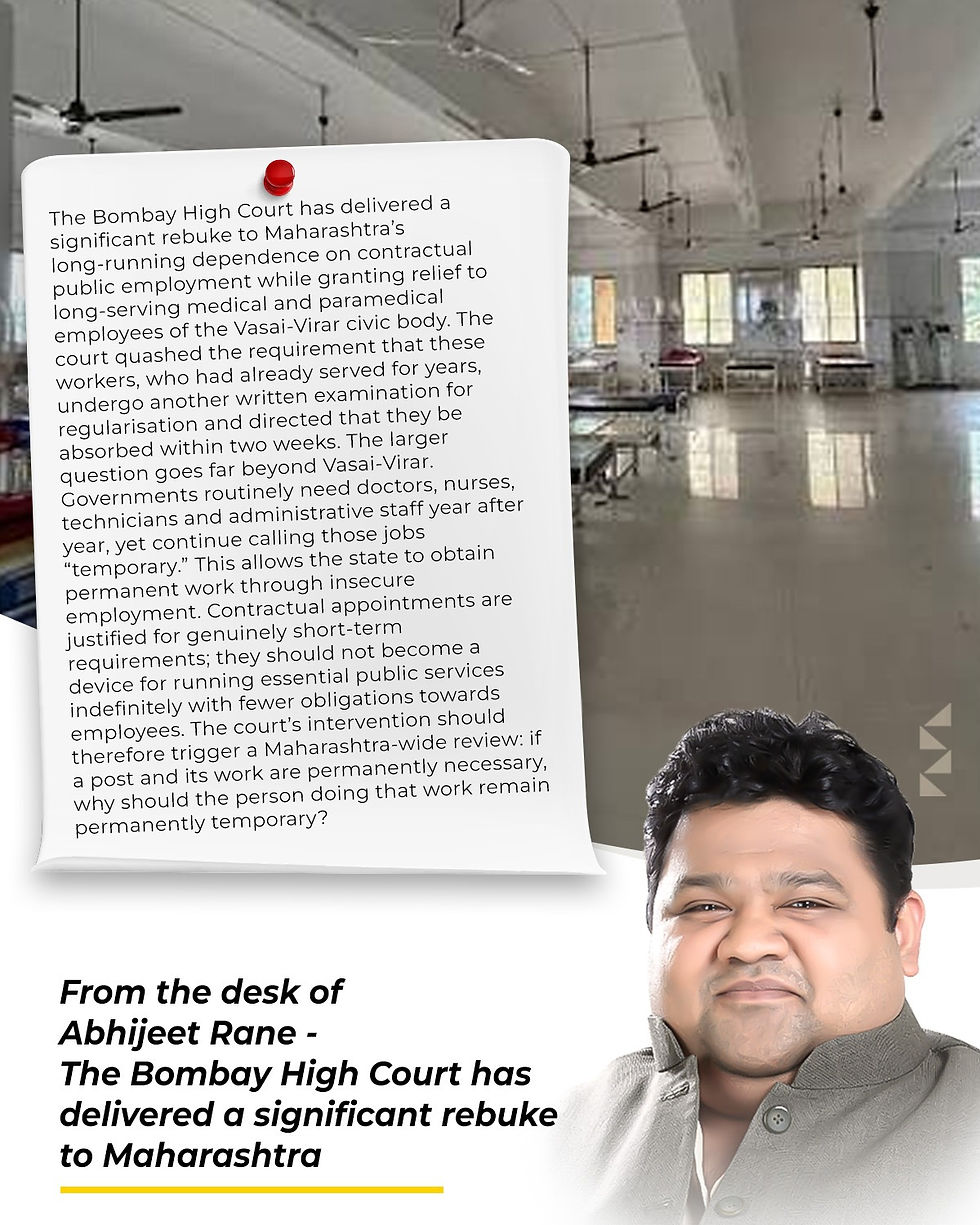
🖋️ *From The Desk of Abhijeet Rane*
The Bombay High Court has delivered a significant rebuke to Maharashtra’s long-running dependence on contractual public employment while granting relief to long-serving medical and paramedical employees of the Vasai-Virar civic body. The court quashed the requirement that these workers, who had already served for years, undergo another written examination for regularisation and directed that they be absorbed within two weeks. The larger question goes far beyond Vasai-Virar. Governments routinely need doctors, nurses, technicians and administrative staff year after year, yet continue calling those jobs “temporary.” This allows the state to obtain permanent work through insecure employment. Contractual appointments are justified for genuinely short-term requirements; they should not become a device for running essential public services indefinitely with fewer obligations towards employees. The court’s intervention should therefore trigger a Maharashtra-wide review: if a post and its work are permanently necessary, why should the person doing that work remain permanently temporary?
🔽
#AbhijeetRane #Maharashtra #Politics #BJP #NCP #Pune #Khopoli #FDA #HighCourt #CivicIssues #Governance #News

Comments