


India’s energy future just took a dramatic turn.
🖋️ *From The Desk of Abhijeet Rane*
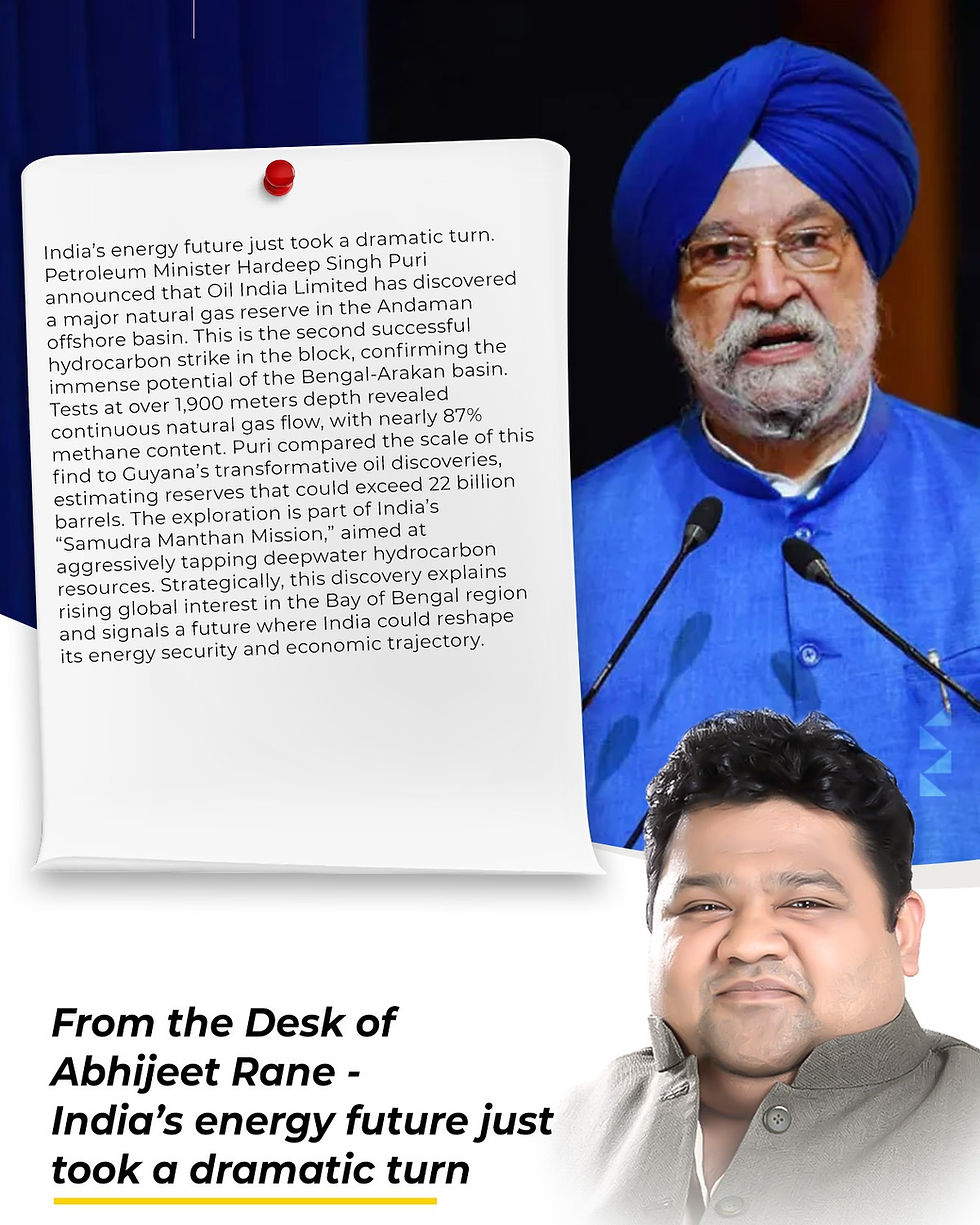
India’s energy future just took a dramatic turn. Petroleum Minister Hardeep Singh Puri announced that Oil India Limited has discovered a major natural gas reserve in the Andaman offshore basin. This is the second successful hydrocarbon strike in the block, confirming the immense potential of the Bengal-Arakan basin. Tests at over 1,900 meters depth revealed continuous natural gas flow, with nearly 87% methane content. Puri compared the scale of this find to Guyana’s transformative oil discoveries, estimating reserves that could exceed 22 billion barrels. The exploration is part of India’s “Samudra Manthan Mission,” aimed at aggressively tapping deepwater hydrocarbon resources. Strategically, this discovery explains rising global interest in the Bay of Bengal region and signals a future where India could reshape its energy security and economic trajectory.
🔽
🖋️ *From The Desk of Abhijeet Rane*
The story of Indian politics often circles back to one question: why always Muslims? From Rahul Gandhi’s survival in Wayanad to Priyanka’s entry, and Mamata Banerjee’s gamble in Baharampur, the sacrifice almost always falls on a Muslim candidate. Rahul lost Amethi but was saved by Muslim-majority Wayanad, only to later vacate it for Priyanka. Mamata, after setbacks, eyes Parliament by replacing Yusuf Pathan, despite his win being rooted in Muslim votes. Across parties, Muslims are courted for support, invoked in fear, but sidelined when power-sharing arrives. Secular leaders exploit the community’s loyalty yet deny them proportional representation. The irony is stark: when votes are needed, Muslims are indispensable; when rewards are due, they are dispensable. Ultimately, the question remains—why must the burden always fall on Muslims?
🔽
🖋️ *From The Desk of Abhijeet Rane*
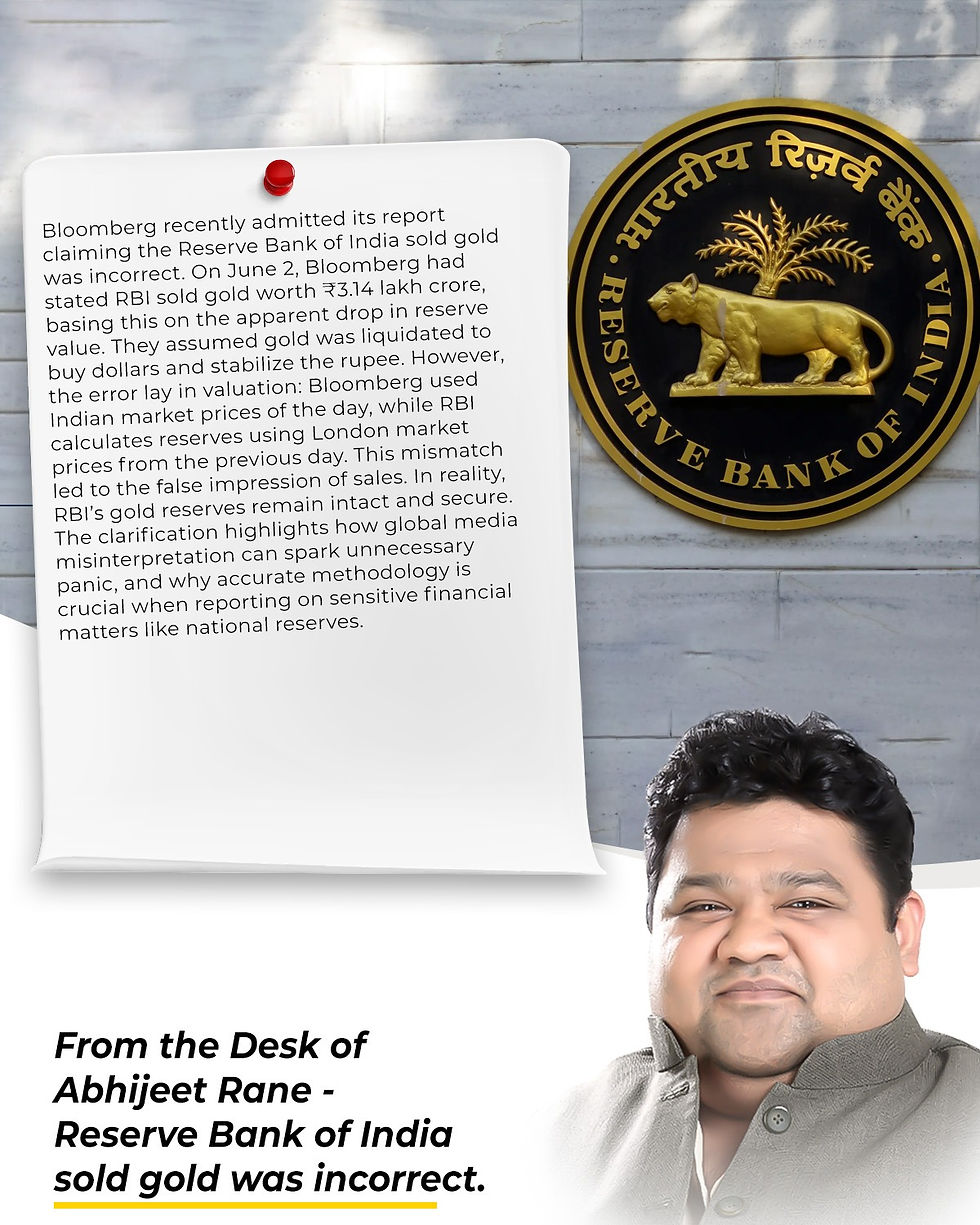
Bloomberg recently admitted its report claiming the Reserve Bank of India sold gold was incorrect. On June 2, Bloomberg had stated RBI sold gold worth ₹3.14 lakh crore, basing this on the apparent drop in reserve value. They assumed gold was liquidated to buy dollars and stabilize the rupee. However, the error lay in valuation: Bloomberg used Indian market prices of the day, while RBI calculates reserves using London market prices from the previous day. This mismatch led to the false impression of sales. In reality, RBI’s gold reserves remain intact and secure. The clarification highlights how global media misinterpretation can spark unnecessary panic, and why accurate methodology is crucial when reporting on sensitive financial matters like national reserves.
🔽
🖋️ *From The Desk of Abhijeet Rane*
World Environment Day should be more than planting saplings for photos. Last year’s floods and this year’s record heat prove how fragile our balance is. India lost nearly $159 billion in productivity due to extreme heat, with 160 billion work hours wasted annually. The World Bank warns climate change could cut GDP by 2.5–4.5%. Already, 57% of districts—home to 76% of the population—face severe risk. Yet governments boast of roads and bridges while cities drown in rain and villages burn in summer. In 11 years, 1.73 lakh hectares of forest land—equal to 16 Sanjay Gandhi National Parks—were sacrificed for industry. True progress means livable cities, protected rivers, and green spaces. Unless citizens demand accountability, future generations will inherit ruins, not a thriving Maharashtra.
🔽
🖋️ *From The Desk of Abhijeet Rane*
New parties keep emerging—NCP factions, Shiv Sena splits, AAP, even Tamil Nadu’s TVK—but nothing truly changes. The Constitution remains untouched, the system intact. Every party eventually becomes part of the same machinery, handing tickets to leaders’ children or loyalists. Dynasties dominate, and winning candidates are recycled from the same elite circles. Ordinary workers remain stuck carrying the carpet, never rising beyond token roles. This cycle ensures that despite fresh names and banners, the outcome is identical: entrenched families return to power, and the system resists reform. The frustration is real—change feels impossible because the structure itself rewards continuity. As the user notes, the meaning of this truth will sink in months or years later, when the same old faces reappear under new party labels.
🔽
#EnergySecurity #NaturalGas #OilIndia #BayOfBengal #EconomicGrowth #MuslimRepresentation #ElectoralPolitics #Secularism #Democracy #RBI #GoldReserves #FinancialMarkets #IndianEconomy #WorldEnvironmentDay #ClimateChange #GlobalWarming #Governance #DynastyPolitics #SystemChange #PublicPolicy #CurrentAffairs



Comments