


Environmental experts have raised concerns over attempts...
🖋️ *From The Desk of Abhijeet Rane*
Environmental experts have raised concerns over attempts to reduce the extent of eco-sensitive areas in the Western Ghats, with the proposed New Mahabaleshwar development again bringing the development-versus-conservation debate into focus. Maharashtra certainly needs roads, tourism, investment and employment, but the Sahyadri cannot be treated as vacant real estate waiting for construction. Every hill cut, forest fragmented and natural drainage channel disturbed carries a cost that eventually returns as landslides, floods, water scarcity or biodiversity loss. The real choice is therefore not “development or environment”; it is intelligent development versus reckless development. Governments routinely calculate the investment a project will attract, but rarely publish an equally rigorous estimate of its ecological cost. The Western Ghats took millions of years to evolve; no government should be allowed to gamble with them for a five-year development headline.
🔽
🖋️ *From The Desk of Abhijeet Rane*
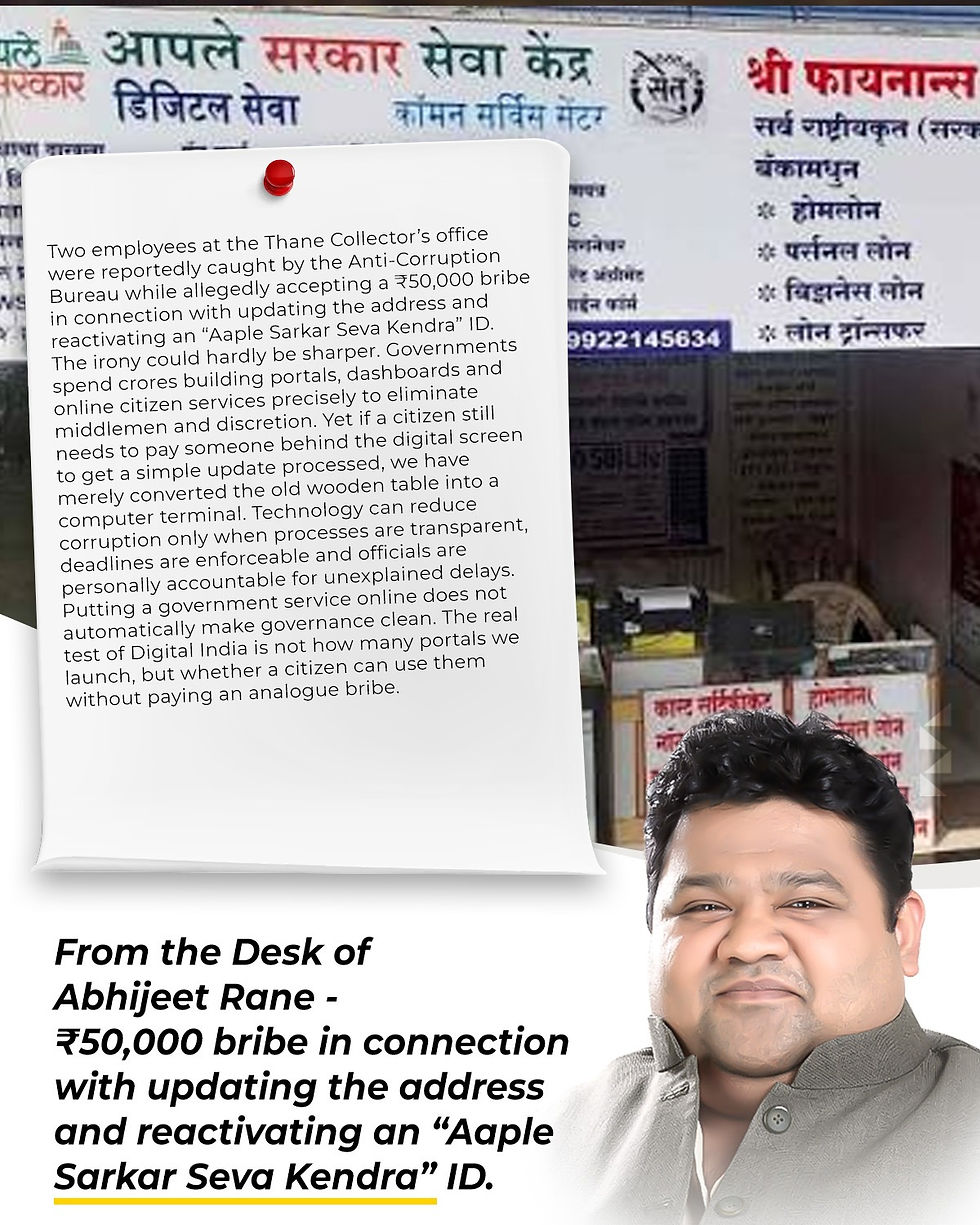
Two employees at the Thane Collector’s office were reportedly caught by the Anti-Corruption Bureau while allegedly accepting a ₹50,000 bribe in connection with updating the address and reactivating an “Aaple Sarkar Seva Kendra” ID. The irony could hardly be sharper. Governments spend crores building portals, dashboards and online citizen services precisely to eliminate middlemen and discretion. Yet if a citizen still needs to pay someone behind the digital screen to get a simple update processed, we have merely converted the old wooden table into a computer terminal. Technology can reduce corruption only when processes are transparent, deadlines are enforceable and officials are personally accountable for unexplained delays. Putting a government service online does not automatically make governance clean. The real test of Digital India is not how many portals we launch, but whether a citizen can use them without paying an analogue bribe.
🔽
🖋️ *From The Desk of Abhijeet Rane*
A murder reported from Pune’s Chandan Nagar area allegedly followed a dispute involving merely ₹600, with abusive remarks during the argument escalating the confrontation. Police will determine individual criminal responsibility, but society must confront the larger question: why are trivial disputes so frequently turning into brutal violence? Money, road rage, social-media comments, romantic disputes and personal insults increasingly seem capable of triggering disproportionate reactions. Policing becomes relevant after the knife is drawn; the deeper challenge begins much earlier. Families, schools and communities have focused intensely on academic achievement and earning capacity, but far less on emotional discipline, conflict resolution and the ability to walk away from provocation. A society cannot station a policeman beside every angry citizen. When a ₹600 quarrel can cost a human life, the crisis is not merely law and order—it is the collapsing value we place on self-control and life itself.
🔽
🖋️ *From The Desk of Abhijeet Rane*
Union Road Transport Minister Nitin Gadkari reportedly reached a Mumbai event late after getting caught in the city’s notorious traffic and subsequently spoke about the limitations of old flyovers and the need for multi-level solutions. There is almost poetic irony in the country’s road minister personally experiencing what millions of Mumbaikars endure every day. Mumbai has built flyovers, sea links, coastal roads and metros, yet congestion repeatedly returns because infrastructure alone cannot compensate indefinitely for poor urban planning, exploding vehicle numbers and badly coordinated transport systems. Gadkari’s experience should therefore become more than an amusing headline. It should prompt governments to rethink whether cities can simply build their way out of congestion. When even the minister responsible for roads cannot beat Mumbai traffic, the traffic jam is no longer an inconvenience—it is a verdict on decades of urban planning.
🔽
🖋️ *From The Desk of Abhijeet Rane*
Mumbai Crime Branch has acted in a case where a developer was allegedly threatened with an extortion demand of around ₹11 crore using jailed gangster Chhota Rajan’s name. The episode raises an uncomfortable question about Mumbai’s organised-crime ecosystem. The era when gangsters openly controlled builders, film producers and businesses may have weakened dramatically, but the commercial value of an underworld name clearly has not disappeared. Even if criminals merely invoke a famous gangster without having any genuine connection to him, the fact that such a threat can still create fear shows how powerful that legacy remains. Police action in individual cases is essential, but intelligence must also focus on networks exploiting old gang identities for new-age extortion. Mumbai may have pushed the underworld off the streets, but the real victory will come only when a gangster’s name stops functioning like a currency of fear.
🔽
#AbhijeetRane #FromTheDesk #Mumbai #Maharashtra #Development #Environment #Corruption #Crime #Traffic #SocialIssues #DhadakKamgar #MumbaiMitra




Comments