


Prime Minister Narendra Modi used his Independence Day...
🖋️ *From The Desk of Abhijeet Rane*
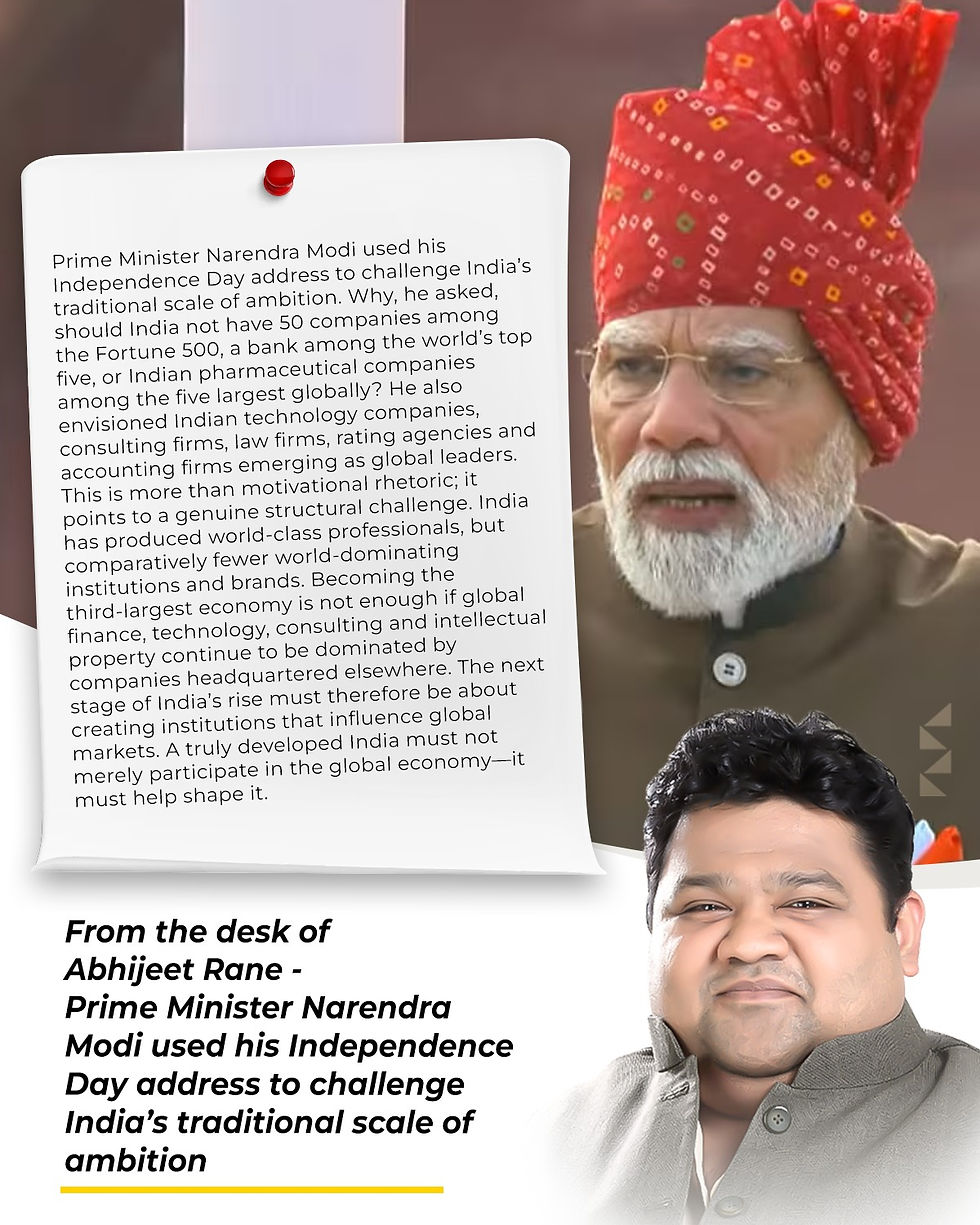
Prime Minister Narendra Modi used his Independence Day address to challenge India’s traditional scale of ambition. Why, he asked, should India not have 50 companies among the Fortune 500, a bank among the world’s top five, or Indian pharmaceutical companies among the five largest globally? He also envisioned Indian technology companies, consulting firms, law firms, rating agencies and accounting firms emerging as global leaders. This is more than motivational rhetoric; it points to a genuine structural challenge. India has produced world-class professionals, but comparatively fewer world-dominating institutions and brands. Becoming the third-largest economy is not enough if global finance, technology, consulting and intellectual property continue to be dominated by companies headquartered elsewhere. The next stage of India’s rise must therefore be about creating institutions that influence global markets. A truly developed India must not merely participate in the global economy—it must help shape it.
🔽
🖋️ *From The Desk of Abhijeet Rane*
Prime Minister Modi placed agriculture among the seven major streams of strength for building Viksit Bharat. His message to Indian agriculture was significant: farmers must move beyond merely producing crops and connect the entire journey “from farm to export market.” He highlighted food processing, chemical-free farming and the opportunity created by India’s expanding Free Trade Agreements. This is precisely where Indian agriculture needs transformation. For decades, agricultural politics has largely revolved around MSP, subsidies, fertilisers and loan waivers. These issues matter, but prosperity cannot come from subsidies alone. India must create global brands around its millets, spices, fruits, processed foods and traditional agricultural products. Farmers need better storage, processing, certification, logistics and direct access to international markets. The farmer should gradually evolve from being merely a producer of commodities into a participant in the global value chain. The future of Indian agriculture lies not only in producing more, but in earning more from every acre.
🔽
🖋️ *From The Desk of Abhijeet Rane*
Prime Minister Modi’s message on defence went beyond the familiar idea of Atmanirbhar Bharat. He argued that India should ultimately become a global supplier of next-generation defence technology, highlighting drones, counter-drone systems, hypersonic technologies and cyber security as crucial areas. This represents an important shift in strategic thinking. A country that depends heavily on foreign suppliers for critical weapons can never enjoy complete strategic autonomy. India has already moved from being overwhelmingly import-dependent towards expanding indigenous defence production and exports, but the next challenge is much harder: India must create technologies that other nations actively want to buy. That requires sustained R&D, private-sector participation, faster procurement cycles and much stronger collaboration between the armed forces, start-ups, universities and defence laboratories. The real test of Atmanirbhar Defence will come when “Made in India” weapons are chosen internationally not because they are Indian, but because they are among the best in the world.
🔽
🖋️ *From The Desk of Abhijeet Rane*
Calling drug abuse a serious challenge confronting India’s youth, Prime Minister Modi appealed for Nasha Mukt Bharat to become a responsibility shared by every family. He referred to the 100-week campaign involving MY Bharat volunteers, NGOs, socio-cultural organisations and spiritual leaders, and urged families themselves to join the fight against addiction. The emphasis on families is important because drug addiction cannot be defeated by policing alone. Law-enforcement agencies must destroy trafficking networks and punish organised suppliers, but prevention begins much earlier—in homes, schools, colleges and communities. India’s demographic dividend can quickly become a social burden if a significant section of its young population is trapped by narcotics. Awareness campaigns, counselling, rehabilitation and mental-health support therefore need to accompany strict enforcement. At the same time, India must aggressively attack the financial networks behind narcotics trafficking. A drug-free India will require both a strong state against traffickers and a compassionate society towards victims of addiction.
🔽
🖋️ *From The Desk of Abhijeet Rane*
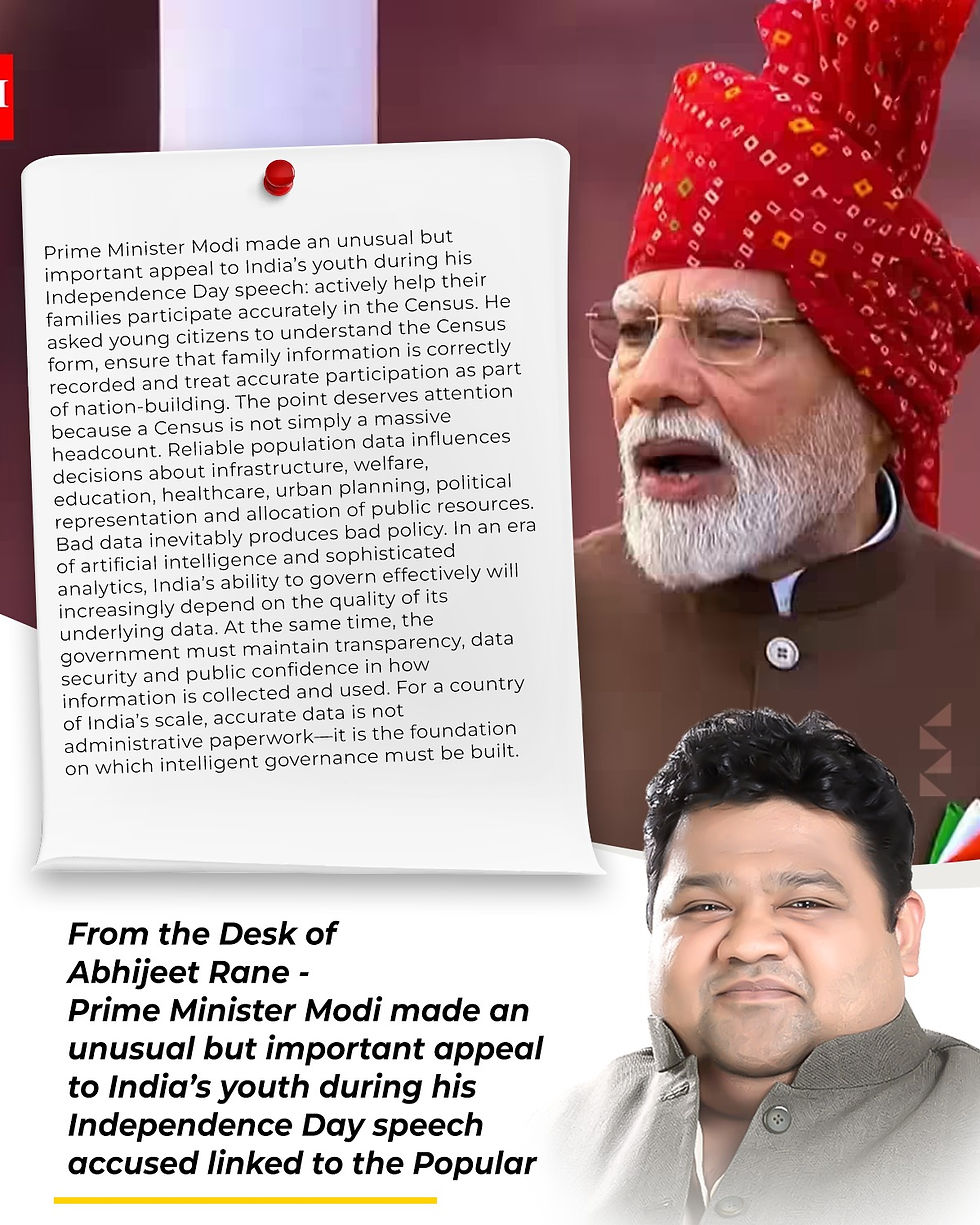
Prime Minister Modi made an unusual but important appeal to India’s youth during his Independence Day speech: actively help their families participate accurately in the Census. He asked young citizens to understand the Census form, ensure that family information is correctly recorded and treat accurate participation as part of nation-building. The point deserves attention because a Census is not simply a massive headcount. Reliable population data influences decisions about infrastructure, welfare, education, healthcare, urban planning, political representation and allocation of public resources. Bad data inevitably produces bad policy. In an era of artificial intelligence and sophisticated analytics, India’s ability to govern effectively will increasingly depend on the quality of its underlying data. At the same time, the government must maintain transparency, data security and public confidence in how information is collected and used. For a country of India’s scale, accurate data is not administrative paperwork—it is the foundation on which intelligent governance must be built.
🔽
#ViksitBharat #NarendraModi #IndiaRising #AtmanirbharBharat #IndianAgriculture #DefenceIndia #NashaMuktBharat #Census2026 #YouthPower #GlobalIndia



Comments