


🖋️ From The Desk of Abhijeet Rane
🖋️ From The Desk of Abhijeet Rane
India’s Aviation Turbulence Demands Transparency and Structural Reform
The recent Indigo crisis has exposed a deeper fragility within India’s fast‑growing aviation sector. With over 65% market share, any disruption in Indigo’s operations inevitably cascades into nationwide chaos. DGCA’s upcoming regulatory reforms—stricter fatigue rules, digital licensing, enhanced audits and ATC strengthening—were designed to improve safety, but they also require airlines to expand staffing and modernise systems. If an airline fails to prepare despite long notice, accountability becomes essential. Equally, passengers deserve timely communication, refunds, and clarity—none of which were adequately delivered during the mass cancellations. India cannot afford monopolistic dependence on a single carrier. Diversifying competition, enforcing compliance, and ensuring transparent investigations are crucial for restoring public trust. The aviation sector’s growth story must be built on reliability, not avoidable disruption.
🔽
🖋️ From The Desk of Abhijeet Rane,
When Insults Become Identity: The Debate Over “Bald” as Harassment
The UK High Court’s ruling that calling a man “bald” can constitute sexual harassment has ignited a surprisingly complex debate about language, gender, and workplace dignity. The case, rooted in an electrician being called a “stupid bald cunt,” forced judges to consider whether certain insults carry gendered weight. Their conclusion—that baldness is statistically and culturally associated with men—places the remark within the scope of gender‑based harassment. Critics argue the ruling stretches equality law too far, while supporters note that appearance‑based insults toward women have long been recognised as discriminatory. What this judgment ultimately highlights is a broader shift: workplaces are increasingly expected to treat personal insults as more than casual banter. Whether one agrees or not, the ruling underscores how evolving norms continue to reshape the boundaries of respect.
🔽
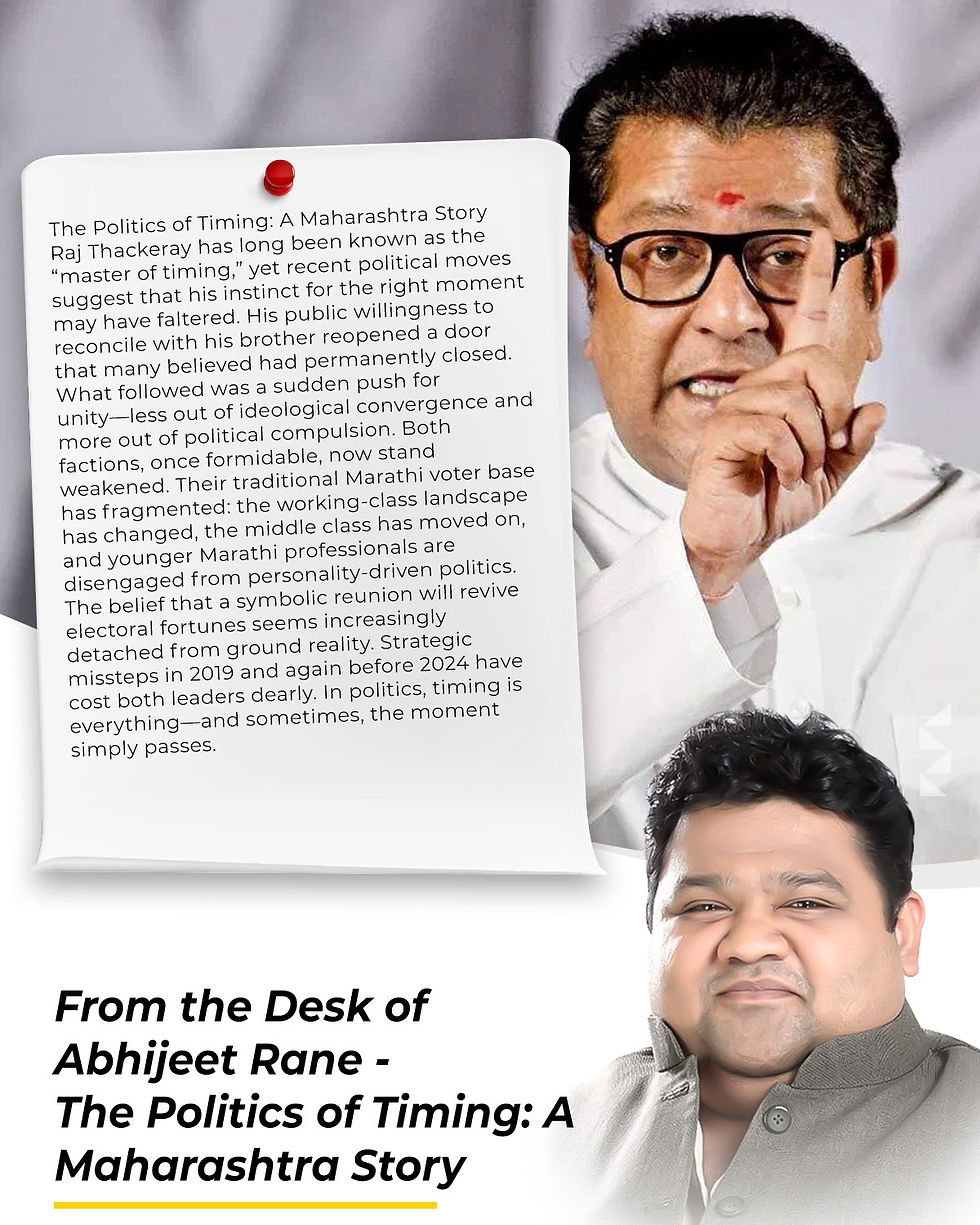
🖋️ From The Desk of Abhijeet Rane
The Politics of Timing: A Maharashtra Story
Raj Thackeray has long been known as the “master of timing,” yet recent political moves suggest that his instinct for the right moment may have faltered. His public willingness to reconcile with his brother reopened a door that many believed had permanently closed. What followed was a sudden push for unity—less out of ideological convergence and more out of political compulsion. Both factions, once formidable, now stand weakened. Their traditional Marathi voter base has fragmented: the working‑class landscape has changed, the middle class has moved on, and younger Marathi professionals are disengaged from personality‑driven politics. The belief that a symbolic reunion will revive electoral fortunes seems increasingly detached from ground reality. Strategic missteps in 2019 and again before 2024 have cost both leaders dearly. In politics, timing is everything—and sometimes, the moment simply passes.
🔽
🖋️ From The Desk of Abhijeet Rane
Nitish Kumar’s ‘Action Mode’ Signals a Push for Administrative Accountability
Chief Minister Nitish Kumar’s latest ultimatum to officers during the Pragati Yatra review reflects a familiar but necessary urgency: development cannot run on files alone. Bihar’s governance model has often struggled with sluggish execution, and the CM’s public warning underscores growing impatience with bureaucratic inertia. Pragati Yatra was designed to bridge gaps between policy and ground reality, yet its success depends entirely on district‑level responsiveness. By demanding timely reports, field verification, and measurable outcomes, Nitish Kumar is attempting to re‑energize an administrative machinery that frequently slips into complacency. However, ultimatums must translate into sustained monitoring, not episodic pressure. Bihar’s development story will advance only when accountability becomes routine, not reactive. The coming months will reveal whether this renewed assertiveness produces real progress or remains another headline.
🔽
🖋️ From The Desk of Abhijeet Rane
Ayodhya’s Diwali: From Sacred Tradition to Global Heritage
The inclusion of Ayodhya’s Diwali on UNESCO’s list marks more than a cultural milestone—it signals India’s civilisational confidence returning to the global stage. For centuries, the festival symbolised light triumphing over darkness, but Ayodhya’s Deepotsav transformed it into a spectacle of collective devotion and cultural pride. Chief Minister Yogi Adityanath’s assertion that Ayodhya’s traditions have earned global recognition reflects a broader shift: India is no longer apologetic about its heritage; it is showcasing it. UNESCO’s acknowledgment validates the efforts to revive Ayodhya’s spiritual identity and positions the city as a cultural beacon. Beyond politics, this recognition belongs to millions who kept the tradition alive through faith and memory. Ayodhya’s Diwali now stands not just as a festival, but as a global symbol of India’s timeless cultural light.
🔽
#AviationCrisis #TransparencyNow #WorkplaceDignity #HarassmentDebate #MaharashtraPolitics #PoliticalTiming #GovernanceReform #AdministrativeAccountability #AyodhyaDiwali #CulturalHeritage #UNESCORecognition


Comments