


The Waqf Board debate reflects a deeper national..
🖋️ From The Desk of Abhijeet Rane
The Waqf Board debate reflects a deeper national conversation about governance, equality, and institutional accountability in modern India. Concerns about transparency, prolonged property disputes, and their impact on ordinary citizens, farmers, and infrastructure projects are legitimate and deserve serious attention. A secular democracy indeed demands uniform legal frameworks that treat all citizens equally, regardless of religious affiliation. However, outright abolition risks disrupting centuries-old charitable endowments supporting education, healthcare, and social welfare within vulnerable communities. The more measured path forward lies in comprehensive reform — digitisation of records, independent oversight, and stronger judicial accountability — rather than dismantling the institution entirely. India's constitutional framework is capable of accommodating both religious endowments and legal equality simultaneously. The real test is not whether Waqf exists, but whether it functions transparently, fairly, and in genuine service of public good.
🔽
🖋️ From The Desk of Abhijeet Rane
India's family courts are witnessing an evolving judicial approach toward matrimonial disputes. While maintenance laws were originally designed to protect financially dependent spouses, several judges have increasingly scrutinized claims where educated, employable individuals seek substantial compensation without demonstrating genuine financial hardship. Justice Shiv Narain Dhingra's landmark family court judgments highlighted this growing concern, emphasizing that maintenance should reflect actual need rather than become a tool for financial leverage. Legal experts across the spectrum now increasingly advocate for gender-neutral matrimonial laws that assess individual circumstances fairly, regardless of gender. Both men and women deserve equal accountability within divorce proceedings. Reforms ensuring transparent financial disclosure, time-bound settlements, and employment capability assessments could significantly reduce misuse while protecting genuinely vulnerable spouses. Ultimately, justice within matrimonial disputes must balance compassion with accountability, ensuring family courts serve their original purpose — fairness for all parties involved.
🔽
🖋️ From The Desk of Abhijeet Rane
The United Arab Emirates has once again demonstrated its zero-tolerance approach toward external threats by dismantling a terrorist network on April 20, 2026. The State Security Department arrested all members of an organization linked to Iran's political-religious doctrine of Wilayat al-Faqih, which advocates absolute clerical authority. Investigations revealed that the group had been conducting covert recruitment meetings, radicalizing Emirati youth, channeling unauthorized funds to suspicious foreign entities, and attempting to infiltrate sensitive locations. With over 27 individuals arrested, this operation exposes Iran's persistent attempts to destabilize Gulf nations through ideological subversion. The UAE's message is unambiguous — national sovereignty and social stability will be defended at any cost. Such decisive action not only strengthens UAE's internal security but also contributes to broader regional stability across the Gulf.
🔽
🖋️ From The Desk of Abhijeet Rane
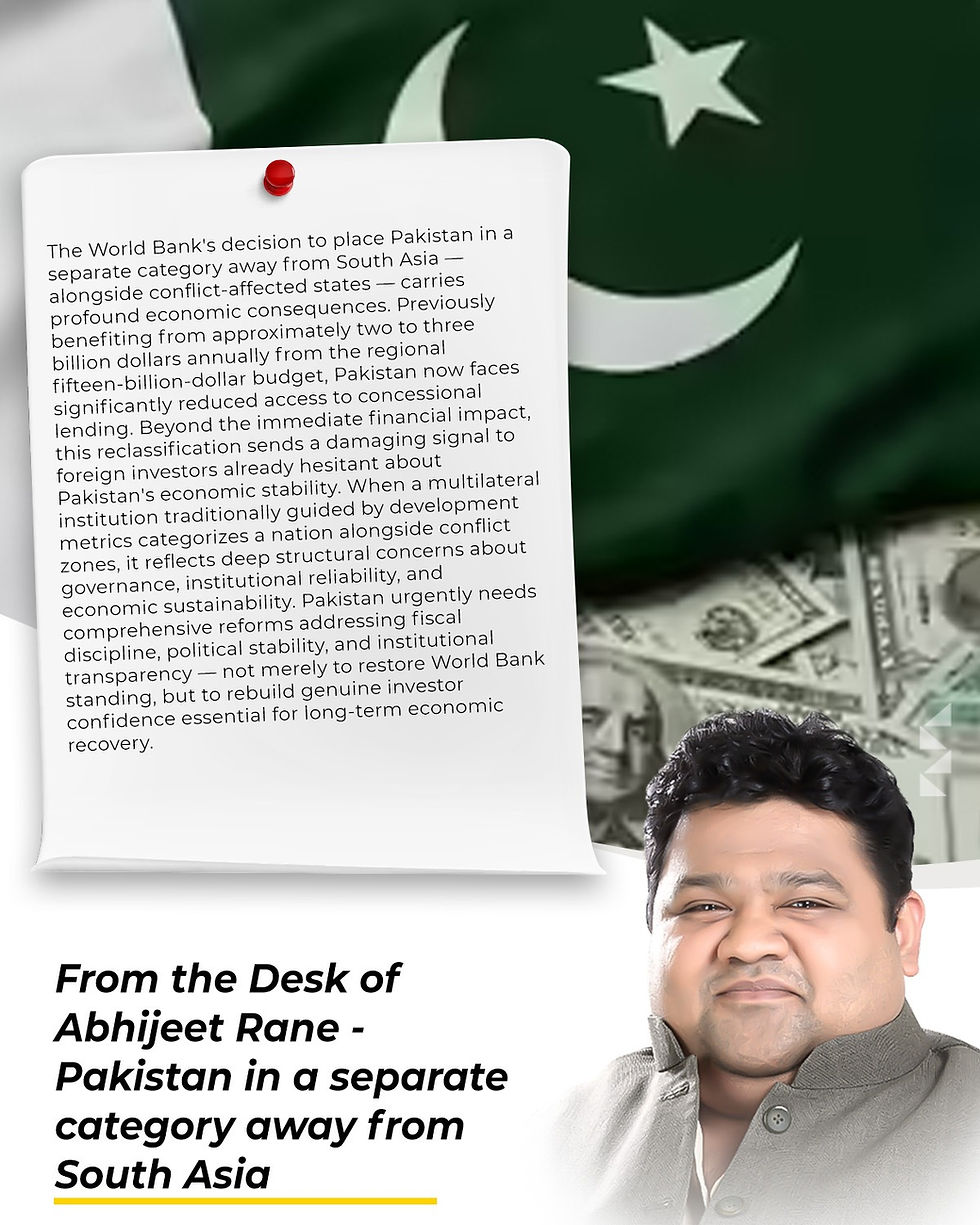
The World Bank's decision to place Pakistan in a separate category away from South Asia — alongside conflict-affected states — carries profound economic consequences. Previously benefiting from approximately two to three billion dollars annually from the regional fifteen-billion-dollar budget, Pakistan now faces significantly reduced access to concessional lending. Beyond the immediate financial impact, this reclassification sends a damaging signal to foreign investors already hesitant about Pakistan's economic stability. When a multilateral institution traditionally guided by development metrics categorizes a nation alongside conflict zones, it reflects deep structural concerns about governance, institutional reliability, and economic sustainability. Pakistan urgently needs comprehensive reforms addressing fiscal discipline, political stability, and institutional transparency — not merely to restore World Bank standing, but to rebuild genuine investor confidence essential for long-term economic recovery.
🔽
🖋️ From The Desk of Abhijeet Rane
Once considered a pivotal player in South Asian geopolitics, Pakistan finds itself increasingly isolated on multiple fronts simultaneously. Economically crippled by debt, diplomatically squeezed between competing powers, and internally fragmented by civil-military tensions, Pakistan's regional standing has deteriorated significantly. Iran's public criticism, World Bank's reclassification, and strained relations with Afghanistan collectively paint a concerning picture of a nation losing strategic relevance. While Pakistan retains utility as an intermediary — as seen during US-Iran backchannel communications — such transactional relevance differs fundamentally from genuine geopolitical influence. Sustainable regional standing requires stable democratic institutions, transparent governance, and economic self-sufficiency rather than perpetual dependence on external patrons. Without serious structural reforms addressing both civil-military imbalance and economic mismanagement, Pakistan risks deepening isolation — a trajectory that ultimately serves neither regional stability nor its own national interests.
🔽
#NationalSecurity #Radicalization #PakistanEconomy #WorldBank #Geopolitics #SouthAsiaPolitics #InternationalRelations




Comments