


🖋️ From The Desk of Abhijeet Rane
🖋️ From The Desk of Abhijeet Rane
Maps, Myths and the Politics of Demography
A viral claim suggests that Bangladesh has released a new map showing parts of Bihar, Odisha and the Northeast as its own. While such assertions often emerge from fringe groups rather than official channels, they reveal how cartography is frequently weaponised for political messaging. The humour circulating online—especially the satire about illegal migrants suddenly finding themselves “back in Bangladesh”—captures public frustration, but it also exposes deeper anxieties about borders, migration and demographic change.The real issue is not a map but the politics around it. South Asia has long been vulnerable to narratives that exploit identity and population shifts. Instead of reacting to every provocative claim, India and its neighbours need transparent dialogue, strong border management and responsible political rhetoric. Otherwise, rumours will keep redrawing maps faster than governments can.
🔽
🖋️ From The Desk of Abhijeet Rane,
Respect the Achievement, Not the Stereotype
The debate around Devavrat’s accomplishment reveals a deeper problem: criticism driven not by merit, but by caste and regional prejudice. Mastering the Yajurveda—especially completing Dand Karma Parayan, which demands reciting nearly 2,000 mantras in straight and reverse order—is an extraordinary intellectual and spiritual feat. Achieving this in just 50 days reflects discipline, memory, and dedication far beyond ordinary expectations. Yet instead of appreciating the effort, some reduce the achievement to caste identity or regional bias. This is where the discourse loses dignity. Excellence deserves recognition regardless of who achieves it. Critique is easy; understanding the depth of someone’s labour is harder. If one cannot appreciate such commitment, silence is better than resentment. Talent, devotion, and scholarship belong to no caste—they belong to the civilisation that nurtures them.
🔽
🖋️ From The Desk of Abhijeet Rane
Debate Over Legacy: What the Argument Really Reveals
Sonia Gandhi’s remark that a political party aims to “erase Nehru and his legacy” has reopened an old debate—who shapes historical memory, and who is responsible for protecting it. For decades, the Nehru legacy was presented through a carefully curated lens, celebrated widely while uncomfortable episodes were often left unexplored. When alternative narratives emerged—through political opponents, researchers, or social media—they naturally challenged that long‑standing image. If any claims about Nehru or later leaders are inaccurate, the most effective response is evidence, not outrage. Silence only deepens public doubt. Ultimately, safeguarding a legacy is the responsibility of those who inherit it, not those who oppose it. If a narrative weakens simply because new facts or interpretations surface, the question is less about erasure and more about the strength of the legacy itself.
🔽
🖋️ From The Desk of Abhijeet Rane
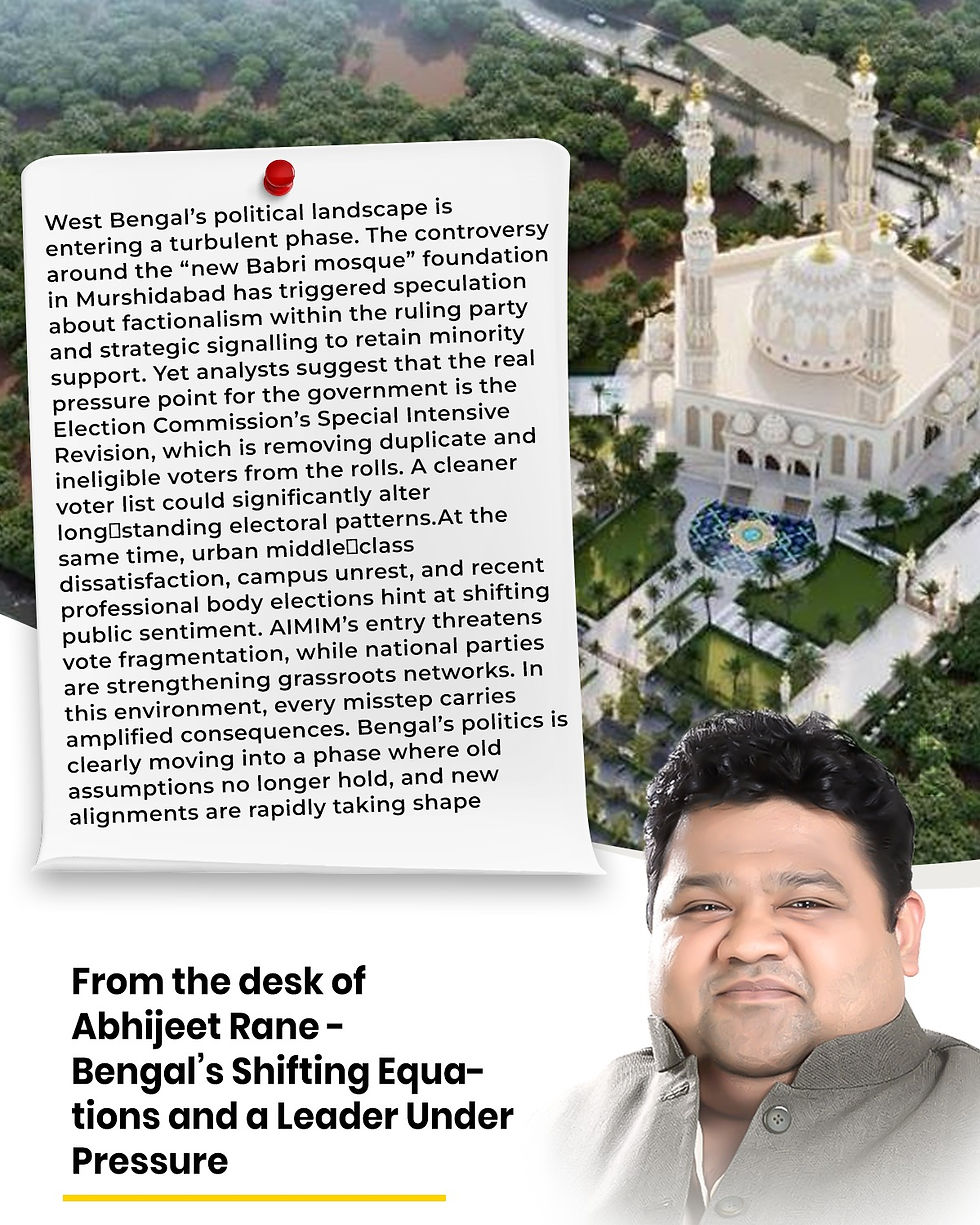
Bengal’s Shifting Equations and a Leader Under Pressure
West Bengal’s political landscape is entering a turbulent phase. The controversy around the “new Babri mosque” foundation in Murshidabad has triggered speculation about factionalism within the ruling party and strategic signalling to retain minority support. Yet analysts suggest that the real pressure point for the government is the Election Commission’s Special Intensive Revision, which is removing duplicate and ineligible voters from the rolls. A cleaner voter list could significantly alter long‑standing electoral patterns.At the same time, urban middle‑class dissatisfaction, campus unrest, and recent professional body elections hint at shifting public sentiment. AIMIM’s entry threatens vote fragmentation, while national parties are strengthening grassroots networks. In this environment, every misstep carries amplified consequences. Bengal’s politics is clearly moving into a phase where old assumptions no longer hold, and new alignments are rapidly taking shape.
🔽
🖋️ From The Desk of Abhijeet Rane
When Temple Funds Expose the Cracks in Cooperative Banking
The recent Kerala dispute—where temple boards sought to shift their deposits from cooperative banks to nationalised banks—has opened a larger conversation about trust, transparency, and financial governance. Cooperative banks refusing to release temple funds and dragging the matter to the Supreme Court was alarming in itself. The Court’s ruling was clear: donations made in the name of the deity belong to the temple, not to any bank’s profit machinery. India’s cooperative banking sector has long suffered from dual regulation, political interference, and repeated scams. Licences often go to politically connected individuals, and deposits are diverted into elections, private businesses, or dubious ventures. When failures occur, depositors lose lifelong savings, as seen in multiple districts—including the massive losses in Beed. The lesson is simple: sentiment, convenience, or slightly higher interest rates cannot replace financial safety. Depositors—and institutions—must think carefully before trusting cooperative banks.
🔽
#Geopolitics #BorderMyths #DemographyDebate #MeritOverCaste #RespectAchievement #LegacyDebate #NehruNarratives #BengalPolitics #VoterRollReform #TempleFunds #BankingReform #FinancialAccountability #FromTheDeskOfAbhijeetRane



Comments