


🖋️ From The Desk of Abhijeet Rane
- dhadakkamgarunion0
- Oct 28, 2025
- 3 min read
🖋️ From The Desk of Abhijeet Rane
Whose Nation Is It Anyway? When a sovereign institution like LIC allegedly channels ₹34,000 crore of public funds into companies linked to a politically favored industrialist, questions of governance and accountability arise. Shiv Sena’s editorial in Saamana accuses the Modi government of subordinating national interest to corporate loyalty, citing The Washington Post’s report on pressure tactics used to favor Adani Group investments. The silence of mainstream Indian media, contrasted with foreign coverage, underscores a troubling erosion of journalistic independence. If these investments are indeed speculative bubbles, as claimed, the risk to 30 crore policyholders is not just financial—it’s moral. A democracy thrives on transparency and checks on power. When public wealth is wagered on private empires, citizens must ask: are we shareholders in a republic, or stakeholders in a conglomerate?
🔽
🖋️ From The Desk of Abhijeet Rane,
Lavani, Politics, and the Right to Expression. Shilpa Shahir’s Lavani performance at the NCP office in Nagpur sparked a storm of cultural and political debate. Critics questioned the appropriateness of traditional dance in a political setting, while Shahir defended her art as a legitimate form of expression. Her response highlights a deeper tension: who decides the boundaries of culture and decorum in public life? Lavani, rooted in Maharashtra’s folk tradition, has long been a medium of commentary, celebration, and resistance. To shame performers for their stage or audience is to silence voices that challenge rigid norms. Politics often borrows from culture to connect with people—why then deny artists their space within it? Shahir’s stand is not just personal; it’s a reminder that art, especially folk art, belongs wherever the people are.
🔽
🖋️ From The Desk of Abhijeet Rane
The Quiet Ledger of Power. In Maharashtra’s political theatre, Devendra Fadnavis is portrayed not merely as a strategist, but as a silent accumulator of debts—political, moral, and territorial. The recent commentary suggests that those who sought short-term gains by cornering him have found themselves outmaneuvered in the long run. Allegations swirl around land grabs, one-rupee leases, and selective silence from leadership when allies turn rogue. The subtext is clear: Fadnavis doesn’t forget. His silence is not absence—it’s calculation. When he speaks, it’s sharp; when he doesn’t, it’s sharper. In a coalition riddled with contradictions, his grip appears firm, his memory long. The editorial tone warns: in a state where everyone’s footprints are on someone else’s land, the man with the ledger holds the real power. Period.
🔽
🖋️ From The Desk of Abhijeet Rane
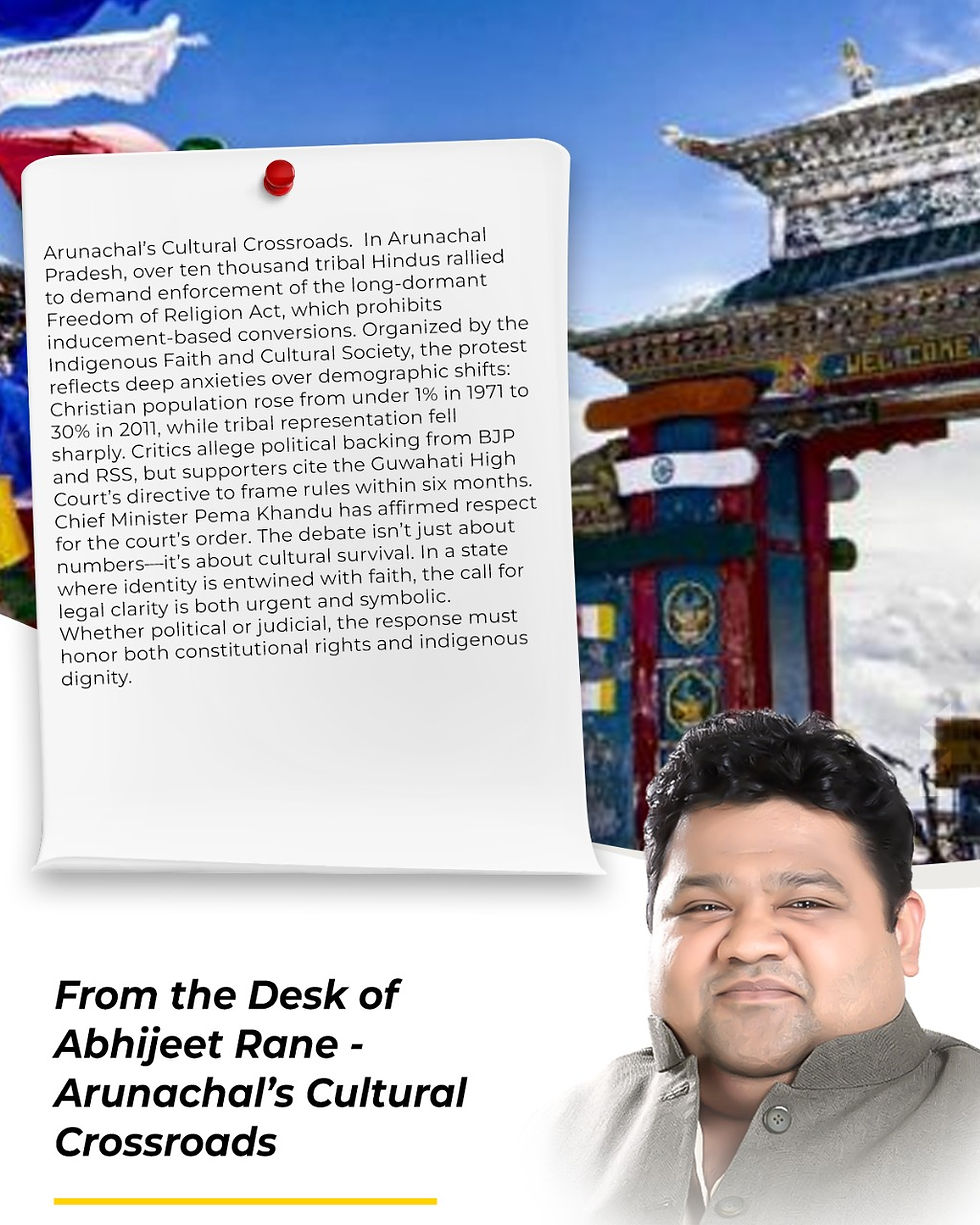
Arunachal’s Cultural Crossroads. In Arunachal Pradesh, over ten thousand tribal Hindus rallied to demand enforcement of the long-dormant Freedom of Religion Act, which prohibits inducement-based conversions. Organized by the Indigenous Faith and Cultural Society, the protest reflects deep anxieties over demographic shifts: Christian population rose from under 1% in 1971 to 30% in 2011, while tribal representation fell sharply. Critics allege political backing from BJP and RSS, but supporters cite the Guwahati High Court’s directive to frame rules within six months. Chief Minister Pema Khandu has affirmed respect for the court’s order. The debate isn’t just about numbers—it’s about cultural survival. In a state where identity is entwined with faith, the call for legal clarity is both urgent and symbolic. Whether political or judicial, the response must honor both constitutional rights and indigenous dignity.
🔽
🖋️ From The Desk of Abhijeet Rane
Fruitless Justice in Phaltan. The tragic suicide of a woman doctor in Phaltan has reignited scrutiny of local police conduct—but the rot runs deeper. A decade-old PIL against an allegedly illegal mosque built on government land remains unresolved, despite a High Court demolition order. Activist Mangesh Khandare and his legal allies faced systemic delays: police failed to provide protection, revenue and law departments under Chandrakant Patil and Devendra Fadnavis remained unresponsive, and civil courts stalled proceedings. Meanwhile, selective enforcement—like swift action against Dhananjay Desai’s property—exposes glaring bias. The state’s machinery, from police to judiciary, appears corroded by inertia and favoritism. When rule of law bends to convenience, justice becomes a casualty. The silence of institutions and the absence of accountability demand not just answers, but reform.
🔽



Comments