


🖋️ From the desk of Abhijeet Rane:
- dhadakkamgarunion0
- Aug 8, 2025
- 5 min read
🖋️ From the desk of Abhijeet Rane:
Rahul Gandhi’s allegations regarding massive voter fraud in the 2024 Lok Sabha elections mark a critical moment in India's democratic journey. His claim that over 40 lakh fake or invalid voters were included in the Maharashtra electoral rolls not only questions the integrity of the Election Commission but also shakes public trust in the electoral process. Backed by a detailed analysis, especially focusing on the Khar constituency, Gandhi alleges organized manipulation through repeated names, false addresses, and clustering of voters, implying that BJP used institutional mechanisms to tip the scales in their favor. If true, this sets a dangerous precedent and calls for urgent electoral reforms and accountability.On the other hand, the state’s ruling leadership, particularly Devendra Fadnavis, has brushed off these claims as politically motivated. Fadnavis has asserted that the elections were conducted fairly and accused Rahul Gandhi of discrediting voters' will just because of the opposition’s defeat. The Election Commission too is now under scrutiny—both in its operational transparency and political independence. Whether these allegations lead to a larger movement or fizzle out as political rhetoric will depend on the evidence Gandhi's camp can present and how the judiciary treats these claims. But undoubtedly, this controversy has reignited a long-standing concern: Is India’s voter list really sacrosanct anymore?
🔽
🖋️ From the desk of Abhijeet Rane:
Prime Minister Narendra Modi’s statement acknowledging the "very heavy personal cost" India may have to bear underscores the gravity of the escalating trade tension with the United States. The trigger lies in the recent tariff hike announced by the US government, significantly impacting imports from India, including steel, aluminum, and other key sectors. Modi’s remarks indicate a shift in tone — from diplomatic caution to resolute national interest — emphasizing that while dialogue remains India’s preference, it will not compromise national dignity and economic sovereignty under external pressure. This statement is a clear signal to both domestic audiences and international powers that India is preparing to stand firm even if economic consequences follow.The core of this issue lies in the broader context of global trade politics, where protectionism and strategic dominance are shaping relationships. Maharashtra’s industrial base is likely to bear the immediate brunt of these tariffs, especially in manufacturing and raw material exports. However, the government’s readiness to handle retaliatory measures shows a matured policy approach. The US has imposed 90% tariffs on a wide range of countries, including key economic partners, and India is just the latest addition. Modi's tone, combining assertiveness with caution, suggests that India is bracing for a prolonged trade battle, but will do so on its own terms — even if that means absorbing economic shocks in the short run for long-term strategic autonomy.
🔽
🖋️ From the desk of Abhijeet Rane:
Eknath Shinde’s frequent visits to Delhi reflect more than just administrative obligations—they point toward deeper undercurrents of political anxiety and power calibration. With the shifting dynamics in Maharashtra politics and the rise of Devendra Fadnavis’s clout within the administration, Shinde appears increasingly preoccupied with securing his relevance and positioning. The recurring trips to Delhi seem to serve as a way to reinforce his proximity to the central leadership and remind the BJP that he is still a crucial pillar in their political arithmetic, especially in the run-up to key elections.At the heart of this situation lies the subtle but growing strain between Shinde and the BJP leadership. Despite having been brought to power with the support of BJP, Shinde now faces the classic dilemma of regional leaders backed by a national party—how to maintain authority without becoming dispensable. His cautious positioning and consistent outreach to Delhi reflect an attempt to walk the tightrope of balancing political identity with alliance politics. The message is clear: Shinde wants to stay indispensable, but the shadow of internal insecurity continues to shape his moves.
🔽
🖋️ From the desk of Abhijeet Rane:
India’s growing confidence on the global stage is clearly reflected in the ongoing tariff standoff with the United States, where despite pressure from President Donald Trump, India has refused to bow down. What makes this episode even more geopolitically significant is Israel’s vocal support for India’s strategic position. Israeli Prime Minister Benjamin Netanyahu’s meeting with Indian Ambassador J.P. Singh not only reaffirmed India-Israel friendship but also signaled to the world that India is not diplomatically isolated, even when dealing with a global superpower like the U.S. Netanyahu’s remarks that "India is a strong partner" reflect a recognition of India’s strategic autonomy and economic relevance.This open endorsement by Netanyahu carries weight because Israel maintains strong relations with both India and the U.S., and yet chose to back India. This shows a subtle shift in how global alliances are being defined—not just by military or economic dominance, but by shared values and resilience. With Netanyahu also expressing interest in visiting India soon and increasing cooperation in defense and economics, it is evident that India-Israel ties are entering a deeper, more strategic phase. In the context of the India-U.S. tariff war, this diplomatic development strengthens India’s positioning as a balanced yet bold global player ready to protect its interests.
🔽
🖋️ From the desk of Abhijeet Rane:
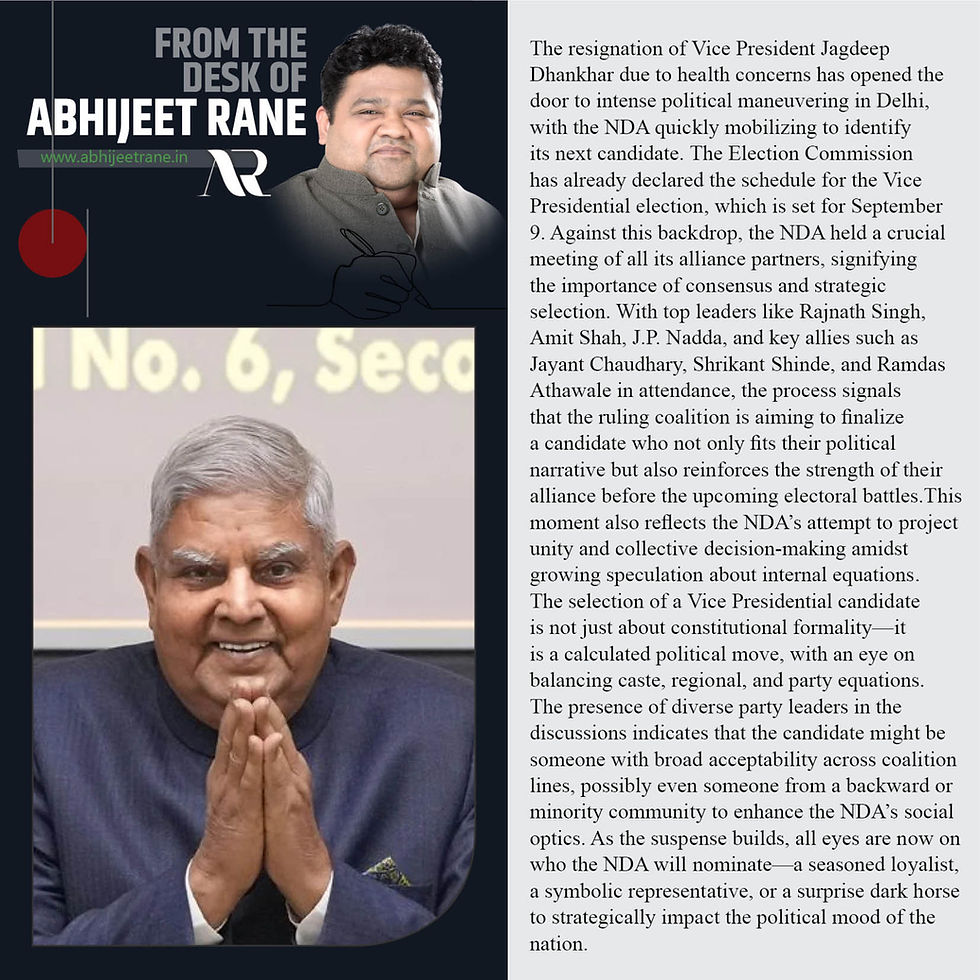
The resignation of Vice President Jagdeep Dhankhar due to health concerns has opened the door to intense political maneuvering in Delhi, with the NDA quickly mobilizing to identify its next candidate. The Election Commission has already declared the schedule for the Vice Presidential election, which is set for September 9. Against this backdrop, the NDA held a crucial meeting of all its alliance partners, signifying the importance of consensus and strategic selection. With top leaders like Rajnath Singh, Amit Shah, J.P. Nadda, and key allies such as Jayant Chaudhary, Shrikant Shinde, and Ramdas Athawale in attendance, the process signals that the ruling coalition is aiming to finalize a candidate who not only fits their political narrative but also reinforces the strength of their alliance before the upcoming electoral battles.This moment also reflects the NDA’s attempt to project unity and collective decision-making amidst growing speculation about internal equations. The selection of a Vice Presidential candidate is not just about constitutional formality—it is a calculated political move, with an eye on balancing caste, regional, and party equations. The presence of diverse party leaders in the discussions indicates that the candidate might be someone with broad acceptability across coalition lines, possibly even someone from a backward or minority community to enhance the NDA’s social optics. As the hu builds, all eyes are now on who the NDA will nominate—a seasoned loyalist, a symbolic representative, or a surprise dark horse to strategically impact the political mood of the nation.
🔽


Comments